
Search “clan crest” online and you’ll find hundreds of shops selling rings, plaques, and stationery stamped with a shield and a surname. Almost none of them will tell you the thing that matters most if you actually care about getting this right: in Scotland, a coat of arms is not a family decoration you can print on a mug. It’s a piece of personal legal property, and using someone else’s is, technically, against the law.
This trips up a lot of diaspora researchers who’ve just started exploring clans and surnames, so it’s worth untangling the terms before you buy anything with a shield on it.
Coat of arms: belongs to a person, not a surname
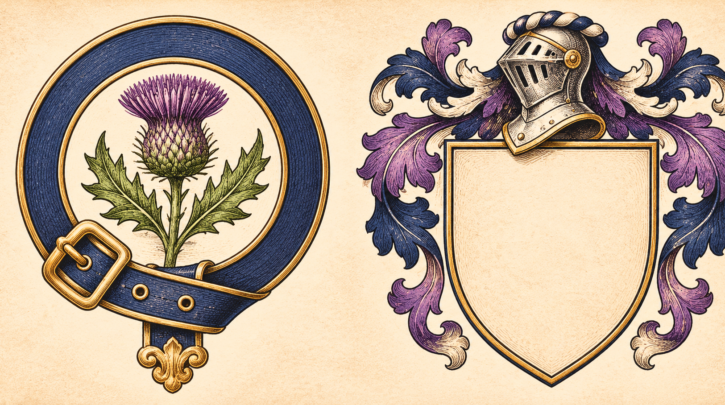
A coat of arms in Scotland is granted by the Court of the Lord Lyon, the heraldic authority for Scotland, to one specific individual. It then passes down, usually to that person’s eldest heir, with each generation typically required to “matriculate” (re-register) the arms with small differences (called “cadency marks”) to show they belong to a cadet branch rather than the head of the family. Under the Lyon Court’s long-standing position, arms are not a shared surname trademark — sharing a surname with the person who was granted arms does not entitle you to use them. Unauthorised use of arms can, at least in principle, still be prosecuted under Scots law, though enforcement in practice is rare and mostly aimed at commercial or clearly fraudulent use.
If your surname is associated with a clan that has a recognised chief, that chief holds the “undifferenced” arms of the name — the version without cadency marks. That is the chief’s personal property, not the clan’s collective logo, however often it’s used that way in marketing.
Clan crest badge: the one that’s actually meant to be worn
What most people picture when they say “clan crest” — a circular strap-and-buckle design with a symbol inside, worn on a bonnet or as a brooch — is properly called a crest badge, and this one really is designed for clan members and associates to wear. The crest badge takes the crest element from the chief’s coat of arms (the figure that would sit above the shield and helmet, such as a hand holding a dagger, or a boar’s head) and surrounds it with a strap bearing the chief’s motto or slogan.
Wearing a crest badge is understood, by long tradition, as a sign of allegiance to that chief — not a personal coat of arms, and not proof of descent. This is genuinely the version made for everyday, non-armigerous clan members to wear, which is why it’s the design you’ll see at Highland games and clan gatherings.
| Coat of Arms | Clan Crest Badge | |
|---|---|---|
| Who owns it | One individual (granted by Lyon Court) | The clan chief owns the crest and motto shown; the badge itself is worn by any member |
| Legal status | Personal property, protected under Scots heraldic law | Traditional, widely used by clan members and associates |
| Who can use it | Only the grantee and, differenced, their direct heirs | Anyone who considers themselves part of, or allied to, the clan |
| Typical use | Seals, formal documents, family use by the armiger | Kilt pins, brooches, bonnet badges, jewellery |
So what can you actually buy and wear?
If a product is sold as a “clan crest badge” using the strap-and-buckle format with your clan’s motto, that’s the traditional, appropriate item — and most reputable Scottish outfitters and clan societies sell exactly this. Where it gets murkier is products marketed as a “family coat of arms” for a surname, sold as though every person with that surname is entitled to the full, undifferenced shield. Strictly, that’s not accurate; you’re wearing or displaying the arms of whichever historical figure was granted them, not a surname-wide emblem.
None of this is really about legal risk for an ordinary person buying a keychain — enforcement against individuals is essentially unheard of. It matters more for getting the history right: understanding that “your family coat of arms” as sold online is usually a marketing shortcut, not a documented family right, is part of separating genuine heraldic and tartan history from the gift-shop version.
If you want to know whether your line actually connects to an armigerous family
That’s a genealogical question, not a heraldic one — and it has to be answered the same way any other ancestral claim is: with documented, sourced generations connecting you to the specific person who held the arms, not just a shared surname. Start with a solid paper trail using statutory records and parish registers before assuming any connection to a titled or armigerous branch of your clan name. If you do believe you have a genuine, documented case for a grant or matriculation of arms, that’s a formal petition to the Lyon Court itself, well beyond what any crest-badge purchase implies.
The short version: wear the crest badge with pride — that’s exactly what it’s for. Just hold the “family coat of arms” merchandise to a slightly more skeptical standard.
Not every clan currently has a recognised chief
Here’s a detail that surprises a lot of people researching their clan for the first time: some historic Scottish clans currently have no chief formally recognised by the Lyon Court, either because the chiefly line died out, became untraceable, or the title has lain dormant while a legitimate heir is sought. In those cases, the clan may be represented instead by a “clan commander” or an armigerous clan society acting in a caretaking role, without full chiefly authority to grant undifferenced arms or a full crest badge in the traditional sense. If you’re trying to track down your clan’s current chief as part of your research, it’s worth checking directly with the clan’s own society, since this status can and does change as claims are resolved.
What it actually takes to be granted arms
For readers curious about the formal process rather than just buying a badge: a grant of arms from the Lyon Court is available to individuals (not families collectively) who can demonstrate a suitable case — historically this leaned heavily on social standing, though today it is available more broadly to individuals with a genuine connection to Scotland who petition and pay the associated fees. It is a formal legal process, involving a petition, a fee, and design work with the Lyon Court’s own heralds, resulting in arms that then belong specifically to that petitioner and their subsequent heirs, differenced accordingly. This is a meaningfully different undertaking from ordering a “family crest” print online, and it’s worth knowing the distinction exists even if you never pursue it yourself.
The bottom line for most researchers
For the overwhelming majority of people exploring Scottish heritage, the crest badge — the strap-and-buckle design bearing your clan’s crest and motto — is exactly the right item to buy, wear, and be proud of. It has centuries of genuine tradition behind it as the mark of clan membership and allegiance, doesn’t require any documented proof of descent, and is available through reputable clan societies and Scottish outfitters without any legal ambiguity at all. Save the skepticism for anything marketed specifically as “your family’s coat of arms” for a surname rather than an individual — that’s the product category worth a second look before you buy.