
Many Americans who describe themselves as “Scottish” or “Irish” are in fact neither—or rather, both. They descend from the Scots-Irish, also called the Ulster Scots: Lowland Scots who settled in the north of Ireland in the 1600s and whose descendants poured into colonial America in the 1700s. Their story is one of the most important—and most misunderstood—in American ancestry, and if your family tradition mixes Scotland, Ireland and the American frontier, this may be your heritage. This guide explains who they were.
The Plantation of Ulster
The story begins in the early 1600s, when, under the Plantation of Ulster, large numbers of Lowland Scots—along with some English—were settled on land in the north of Ireland. These settlers were overwhelmingly Presbyterian, bringing their Scottish church, language and culture with them, and they remained a distinct community in Ulster, separate from the native Irish Catholic population. Over several generations they became the people later known as the Ulster Scots: Scottish in origin and faith, but by now rooted in Ireland.
Not sure where to start with your Scottish ancestry?
Get the Scottish Genealogy Quick-Start Checklist — a 5-step path to your first real ancestor record, plus the one archive that holds almost everything.
The great emigration to America
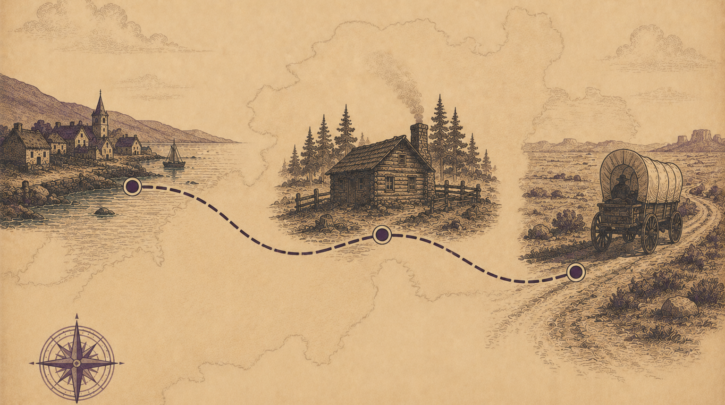
In the 1700s, especially from the 1710s onward, the Ulster Scots emigrated to colonial America in enormous numbers—driven by rack-renting landlords, religious and economic discrimination, and hard times in Ulster, and pulled by the promise of land in the colonies. They landed chiefly in the middle colonies, above all Pennsylvania, and then pushed south and west along the frontier—down the Great Wagon Road into Virginia, the Carolinas and the southern Appalachian backcountry. Fiercely independent and Presbyterian, they became the archetypal American frontier people, and their descendants spread across the expanding United States.
Neither simply Scottish nor Irish
The crucial thing to grasp is that the Scots-Irish are a distinct people, not to be confused with either the native Irish or Scots who stayed in Scotland. In America they were called “Scotch-Irish” (an older form) or Scots-Irish precisely to distinguish them—Protestant, Presbyterian, Scottish in origin but by way of Ulster. This matters enormously for research, because a family tradition of “Irish” roots may in fact lead to Ulster and then back to Lowland Scotland, while a tradition of “Scottish” roots may run through Ireland rather than directly from Scotland.
Scots-Irish research often runs America → Ulster → Scotland. Start with the emigrant in finding your emigrant ancestor, and use the records hub for the Scottish end.
Researching a Scots-Irish line
Tracing the Scots-Irish is genuinely challenging, because the line typically passes through two migrations and two sets of records. From an American ancestor you must work back to their arrival, then to the family’s time in Ulster (using Irish and Presbyterian records, which have their own gaps and history), and only then—if you are fortunate—back to the Lowland Scottish origin, in the parish registers and other Scottish sources this site covers. Presbyterian church records, on both sides of the Irish Sea, are often central. It is a demanding trail, but a deeply rewarding one, uncovering a heritage that shaped both Ulster and America.
A heritage worth understanding
The Scots-Irish contributed profoundly to American life—to its frontier, its Presbyterianism, its music and its character—and they are among the largest ancestral groups in the United States, especially through the South and Appalachia. For descendants, recognising a Scots-Irish heritage resolves the puzzle of a family that seems both Scottish and Irish, and opens the door to a rich, three-cornered history spanning Scotland, Ulster and America. If your roots run this way, understanding the Ulster Scots is the key that makes sense of them—and, ultimately, connects you back to the Lowland Scottish origins from which the whole story began.
Signs your family may be Scots-Irish
Because the Scots-Irish are so often mislabelled, a few signs can alert you to this heritage. A family tradition that is vaguely “Irish” but Protestant and Presbyterian rather than Catholic is a strong hint, as is arrival in colonial America—especially through Pennsylvania—in the 1700s, followed by settlement along the Appalachian frontier. Surnames that are Lowland Scottish in origin, a deep Presbyterian church involvement, and a family that seems to blend Scottish and Irish associations all point the same way. If several of these fit, treat the line as potentially Scots-Irish and plan for the three-stage trail—America, then Ulster, then Lowland Scotland—rather than expecting a direct Scottish origin. Recognising the pattern early saves a great deal of fruitless searching for a Scottish birthplace that in fact lies on the far side of a generation or two in Ireland.