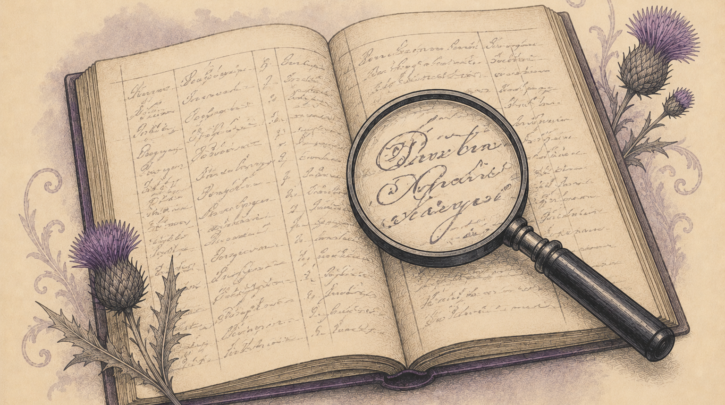

The obstacle that stops many people tracing Scottish ancestry before the modern era is the records themselves: old handwriting, unfamiliar words, the occasional Latin phrase. It is a smaller barrier than it looks. Scottish records are largely formulaic, so you are not translating prose—you are recognising a fixed set of words in a predictable structure. Learn a few dozen terms and the shape of each record, and you can read most of what you will meet. Here is how.
The handwriting
Older Scottish records—especially the parish registers and kirk session records of the 1600s and 1700s—are written in an older style of hand (the “secretary” hand and its successors) that takes acclimatisation. Letters are formed differently from modern writing, and a few are easily confused at first. But the hand becomes familiar with practice, and—crucially—because the records are formulaic, context tells you what a word should be before you can fully read it: after a date in a baptism comes a name, then the parents. Reading in context is the single most useful trick.
Not sure where to start with your Scottish ancestry?
Get the Scottish Genealogy Quick-Start Checklist — a 5-step path to your first real ancestor record, plus the one archive that holds almost everything.
Essential Scots and Latin terms
A small vocabulary unlocks most entries. Among the words you will meet:
- relict (widow), spouse (wife or husband), lawful son/daughter (legitimate child).
- umquhile (late, deceased), residenter (resident), indweller (inhabitant).
- proclaimed (banns read before marriage), compeared (appeared, as before the kirk session).
- In Latin, older entries may use filius/filia (son/daughter), natus/baptizatus (born/baptised), uxor (wife).
Dates and the old new year
One Scottish quirk deserves attention. Before 1600, Scotland began its year on 25 March, not 1 January; from 1600, Scotland moved new year to 1 January (well before England did). So a date such as “February 1595” in the very oldest records may fall in what we would call 1596. Later date changes (the switch to the Gregorian calendar in 1752) affect Scottish and English records alike. For most records you will use, dates are straightforward once you can read the hand—but the pre-1600 new year is worth remembering for early work.
Practice on real records—start with your own family’s. Access them via the ScotlandsPeople service; everything is on the records hub.
Building the skill
Reading old Scottish records is a skill that compounds quickly. A few habits speed it: read in context, letting the fixed format tell you what to expect; build a personal alphabet from letters you can read clearly; keep a glossary of the Scots and Latin terms; and compare the same name across several records to resolve ambiguous letters. Pair this with an understanding of Scottish naming, so you can anticipate the given names, and within an afternoon’s practice most people find they can read their family’s history in the original hand. The records are formulaic, the vocabulary small, and the reward—reading a 1740 baptism of your own ancestor—is immense.
Working through your first record
The fastest way to learn is to decode one complete record slowly. Take a single baptism from your parish on ScotlandsPeople, identify the fixed parts of the entry that never change, and then isolate the handwritten details: the date, the child’s name, the parents’ names, the place. Look up any word you cannot place in a glossary of Scottish genealogical terms. By the time you have fully understood one entry, you will recognise the structure in every other entry of the same type, because they are built on the same template—and the kirk session and other records follow their own consistent patterns.
Keep a personal cheat-sheet as you go—the event words, the Scots and Latin terms, the way your particular clerk forms tricky letters, the abbreviations he favours. Within a few records this becomes second nature, and the work shifts from laborious decoding to quick scanning for the names and dates you need. The handwriting that looked impenetrable at first becomes, with surprising speed, simply your ancestors’ handwriting—readable, and even familiar.
Tools and help
Lean on the resources that exist. Printed and online glossaries of Scots and Latin genealogical terms, palaeography (old-handwriting) guides and tutorials aimed at Scottish records, and word lists for church and legal documents all smooth the way. The active Scottish genealogy community—through societies and online forums—is generous in helping decipher a stubborn entry, so a word or name that defeats you is rarely a true dead end. Combined with an understanding of Scottish naming, which lets you anticipate the given names, these aids turn the intimidating prospect of old Scottish handwriting into a skill you genuinely come to enjoy—and one that unlocks the deepest and most rewarding records of all.