
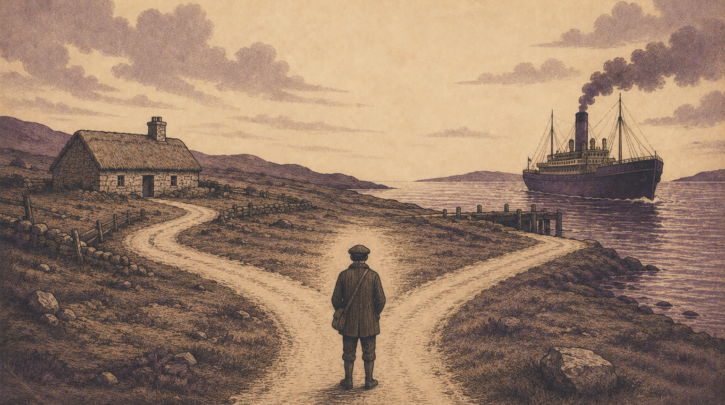

Why did so many Scots—a great share of the nation—leave their homeland over two centuries? The decision to emigrate was rarely made lightly, and for many Highlanders it was not a decision at all but a forced expulsion. Understanding what drove your ancestors to go deepens your sense of their story and explains the pattern of the migration. The causes were a mix of hardship at home and promise abroad, and they differed sharply between the Highlands and the Lowlands. This guide explains them.
The Highland catastrophe
The most wrenching cause was the transformation of the Highlands. After the defeat of the Jacobite rising at Culloden in 1746, the old clan society was deliberately dismantled, and over the following century the Highland Clearances saw landlords remove tenants from the land—often by force—to make way for large-scale sheep farming and, later, sporting estates. Families who had lived on the land for generations were evicted, and many had little choice but to emigrate. The Highland potato famine of the late 1840s deepened the disaster, and some landlords sponsored—or coerced—the emigration of their now-destitute tenants. For Highlanders, then, emigration was frequently expulsion, not choice.
Not sure where to start with your Scottish ancestry?
Get the Scottish Genealogy Quick-Start Checklist — a 5-step path to your first real ancestor record, plus the one archive that holds almost everything.
Lowland change and opportunity
The Lowland emigration, larger in total, had different roots. The agricultural “improvements” of the eighteenth and nineteenth centuries reorganised farming and displaced many rural workers; the Industrial Revolution drew people into—and then sometimes out of—crowded, hard-pressed towns; and periodic economic downturns pushed families to seek better prospects abroad. For many Lowland Scots, emigration was a considered choice in pursuit of land, wages and opportunity unavailable at home—a bet on a better life rather than a flight from disaster.
The pull of the New World
Alongside these pressures at home was a powerful pull from abroad. North America and, later, Australia and New Zealand offered cheap or free land, higher wages, and room to rise beyond the constraints of Scottish society. Letters home from those who had gone told of opportunity; emigration agents and, at times, government or landlord assistance schemes promoted and funded the passage; and the success of earlier emigrants made the leap feel less daunting. For Lowlander and Highlander alike, the promise of the New World was a genuine and growing attraction.
Your ancestor’s reasons were part of this larger story. Trace their individual journey in finding your Scottish emigrant ancestor, back to the parish they left.
Chain migration and the diaspora
Once Scots had established themselves abroad, chain migration took over: relatives and neighbours followed those who had gone before, so emigrants from one glen or parish often ended up in the same overseas community. This is why Scottish settlement abroad is so clustered—whole districts of Nova Scotia or the Carolinas drawn from particular corners of Scotland—and it is a valuable clue for the researcher, since your ancestor’s neighbours abroad often came from their home area in Scotland.
Understanding your ancestor’s choice
For your own family, the particular blend of reasons may never be fully known, but the context tells you much. Whether they were Highland or Lowland, the decade they left, the place they settled, and whether others from their area went too all hint at why. A Highland family cleared from a glen in the 1840s and shipped to Cape Breton fits one pattern; a Lowland tradesman sailing to seek work in an American city fits another. Recovering that pattern—and the individual records behind it—turns a statistic back into the human decision, or the human tragedy, your ancestors actually lived, and sets the stage for tracing them back to Scotland.
Emigration was rarely one single cause
In practice, most emigrant families left for a tangle of reasons rather than a single one, and it helps to hold that complexity in mind. A Highland family might be pushed by a clearance and pulled by relatives already established in Cape Breton; a Lowland tradesman might leave because a downturn cost him work and because cheap American land promised his children a future he could not give them at home. Push and pull worked together, and the balance differed from family to family and decade to decade. For your own ancestors, the surviving records rarely state a motive outright, but the surrounding facts—where and when they left, whether they went alone or with a community, what conditions prevailed in their home area at the time—let you reconstruct a plausible and often moving picture of why they made the great decision to go.