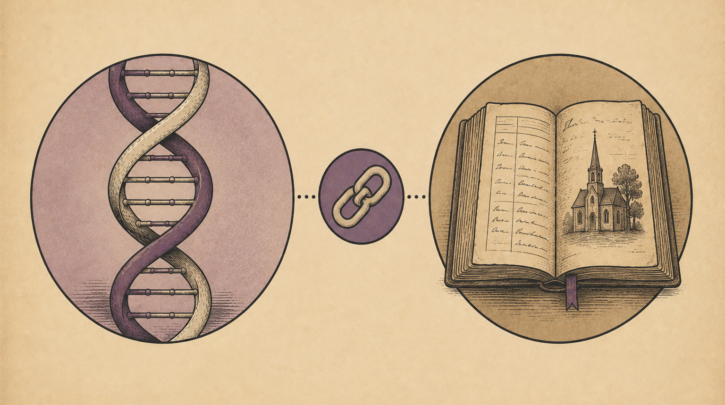

Most guides to DNA and genealogy tell you, in the abstract, to “confirm your match in the records.” That’s correct advice, but it skips the part that actually matters: what happens when the record doesn’t say what the match’s tree claims it says? Below is a walk-through of one hypothetical match, from the first shared-DNA notification through to a kirk session entry that changes the whole picture — the real back-and-forth of proving a Scottish connection, not just the tidy version.
A note before we start: the names, dates, and parish below are an illustrative composite built to walk through the method, not a real case. The record types, the sequence of searches, and the kind of discrepancy involved are all typical of genuine Scottish research.
The Match: A Promising Tree, an Unproven Connection
Call her “Fiona” — an AncestryDNA match sharing a moderate amount of DNA with you, consistent with a third-to-fourth cousin relationship. Fiona’s tree traces back to a couple in Perthshire: John Baxter and Agnes Reid, married in 1798. Your own tree, built independently, comes down through a Robert Baxter, born around 1823, whom family tradition places as a son of John and Agnes. On paper, this looks like exactly the kind of clean confirmation genetic genealogy promises: two independently built trees pointing to the same couple, with DNA backing it up.
That’s the hypothesis. It is not yet a documented relationship — as we cover in our broader guide to Scottish records, shared DNA tells you a relationship exists, not exactly what it is. The next step is testing the hypothesis against actual documents, one generation at a time.
Not sure where to start with your Scottish ancestry?
Get the Scottish Genealogy Quick-Start Checklist — a 5-step path to your first real ancestor record, plus the one archive that holds almost everything.
Step One: Checking the Old Parish Registers
Robert’s supposed birth year, 1823, falls before Scottish civil registration begins in 1855, which rules out the statutory records and puts the search squarely in the Old Parish Registers (OPR) instead. A search of the Perthshire parish OPR for the Baxter/Reid marriage confirms it easily enough: John Baxter and Agnes Reid, married 12 June 1798, exactly as Fiona’s tree has it. Good start.
The baptism entries are where it gets interesting. The OPR shows three children baptised to John Baxter and Agnes Reid in that parish: Janet (1799), William (1801), and Margaret (1804). No Robert. No baptism entry at all for a child of that couple in 1823, or in any nearby year. If Robert really was their son, the register that should record his baptism simply doesn’t.
This is the point where a less careful researcher stops looking and assumes the baptism was “just never recorded” — a real possibility with OPRs, which are famously incomplete, but not one to reach for before other explanations are checked. Before assuming a gap in the register, it’s worth asking a different question: is Robert’s baptism missing because it never happened in this parish under this name — or because something about his birth made a normal baptism entry the wrong place to look?
Step Two: When the Register Doesn’t Fit, Try the Kirk Session
This is exactly the situation kirk session records exist to resolve. Where the OPR records the sacraments — baptisms, marriages, burials — the kirk session minutes record the parish’s own church-court business: discipline cases, poor relief, and, relevant here, cases of ante-nuptial or extramarital fornication, in which the Session formally recorded who a mother named as the father of a child born outside the bounds the Kirk expected. These entries can be uncomfortable reading, but for family historians they’re often the single richest source available for exactly the situations where a parish register alone goes quiet.
Searching the same parish’s kirk session minutes for 1822–1823 turns up an entry: in November 1822, Agnes Reid, “relict of John Baxter” — meaning she was by then a widow — appeared before the Session and confessed to fornication, naming Alexander Kerr, a farm servant in the parish, as the father of the child she was carrying. The child, born the following spring and baptised privately rather than through the normal parish register process, was recorded in the kirk session’s own book as “Robert, son to Agnes Reid.”
That single entry answers the question the OPR couldn’t: Robert was Agnes Reid’s son, but not John Baxter’s. John had died before Robert was conceived, and Robert’s biological father was Alexander Kerr, not a Baxter at all — which explains, immediately and completely, why no baptism for “Robert Baxter” exists in the ordinary parish register. He was baptised as Agnes Reid’s child through the church court process that handled exactly this kind of birth, and the surname “Baxter” attached to him later, informally, as the name of his mother’s late husband and the household he grew up in.
Step Three: What This Actually Means for the DNA Match
Here’s the part that trips people up: this discovery doesn’t break the DNA match with Fiona — it corrects the tree. You and Fiona both descend from Agnes Reid, and the shared DNA is entirely genuine. What changes is the shape of the relationship. If Fiona’s line comes down through one of Agnes’s Baxter children (Janet, William, or Margaret) and yours comes down through Robert, you and Fiona are still cousins through Agnes Reid — but Robert is your mother’s or father’s line’s connection to Agnes by birth, not by any blood tie to John Baxter or the Baxter surname at all.
This has a very practical consequence if you’d been hoping to extend the line further back using the Baxter surname: you can’t. Any further research on Robert’s paternal ancestry has to follow Alexander Kerr, not the Baxter family the tree assumed. This is also exactly the kind of situation where a Y-DNA test would have caught the discrepancy immediately, had one been available — a male-line Baxter descendant’s Y-DNA simply would not match a male-line Kerr descendant’s, regardless of what any paper tree said. Where a surname-line brick wall doesn’t add up the way autosomal matches and trees suggest it should, that mismatch is itself a clue worth taking seriously rather than explaining away.
Building the Documented Chain
Once the kirk session entry is in hand, the connection between you and Fiona is no longer a DNA-based hypothesis — it’s a documented one, and it’s worth recording it that way, generation by generation, rather than leaving it as a note in a tree app:
- Agnes Reid — confirmed via OPR marriage entry, 1798, and kirk session minute, November 1822
- Robert (surname Baxter, by usage; father Alexander Kerr) — confirmed via kirk session baptism entry, 1823, naming both mother and father
- Robert’s descendants down to you — confirmed via whichever mix of OPR, statutory records, and census entries carries the line forward past 1855
- Janet, William, or Margaret’s descendants down to Fiona — the same standard applied to her line, ideally with her cooperation rather than taking her tree on faith
Both the OPR entries and the kirk session minutes for most Scottish parishes are searchable through ScotlandsPeople, though kirk session material is less consistently indexed than the OPRs themselves — expect to browse digitised minute books page by page around a target date rather than searching by name directly. The National Records of Scotland’s own official guide to church records is worth reading before you start, since it explains exactly which record series (CH1 through CH16) cover which denominations and periods, and which ScotlandsPeople does and doesn’t hold in digitised form.
What This Case Teaches About Method, Not Just This Family
A few lessons here generalise well beyond this one hypothetical Baxter/Reid/Kerr example:
- A missing baptism is a question, not a dead end. Before assuming a record was simply never made, check whether the child’s circumstances (illegitimacy, a parent’s death, a family dispute) might have routed the record somewhere other than the ordinary parish baptism list.
- Kirk session records are the natural second search after the OPR comes up short, particularly for any birth that looks irregular, early, or unexplained relative to a couple’s marriage date.
- A DNA match can be entirely genuine while a tree is still wrong. The shared DNA between you and Fiona never lied; the assumption about which surname line carried it did.
- With a common Scottish surname — and Baxter is common enough in Perthshire to have several unrelated families in the same parish — this kind of correction matters even more, since the wrong assumption could otherwise merge two unrelated Baxter lines. Our guide to common Scottish surnames covers this risk in more depth, and our guide to breaking Scottish genealogy brick walls covers other situations where a register’s silence is itself a clue.
A Reminder on Citizenship Claims
If your interest in a case like this extends to a British citizenship claim, it’s worth being clear-eyed about two things. First, most descendants of Scottish emigrants don’t qualify by descent at all, since British citizenship generally passes only one generation to a child born abroad. Second, and specifically relevant here, DNA evidence and even a well-documented kirk session correction carry no legal weight in a citizenship application — citizenship turns on a documented chain of births and legal status, which for a case like Robert’s would need to reflect his actual legal parentage as recorded, not simply his genetic one. This is informational only, not legal advice; verify any citizenship question directly with the UK Home Office.
The Payoff
This is what “connecting DNA to records” actually looks like in practice — not a single triumphant match confirmed on the first try, but a hypothesis, a gap, a second record type that fills the gap, and a corrected, better-documented tree at the end of it. Scotland’s records are unusually good at rewarding this kind of persistence: where many countries’ equivalent church court records are patchy or lost, Scottish kirk session minutes survive in real depth, and pairing them with the OPR and, past 1855, the statutory records gives you a genuine shot at resolving exactly the kind of discrepancy this Baxter/Reid case illustrates. Whether your own next step is confirming a cousin match, tracing a specific ancestral parish, or eventually planning a heritage trip to stand in the parish itself, the discipline is the same: let the DNA point you toward a question, and let the records answer it. Start, or continue, with our full research guide if you’re building this process out for your own family.