
Beyond the baptisms, marriages and burials of the parish registers lies a richer, more human source that many researchers overlook: the kirk session records. The kirk session was the local court of the Church of Scotland, and its records—of discipline, poor relief and the everyday business of the parish—can both fill gaps in your tree and bring your ancestors vividly to life. This guide explains what they are and how to use them.
What the kirk session was
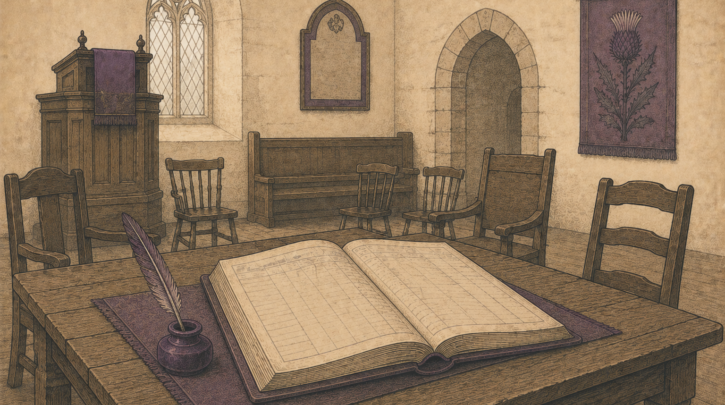
In each Church of Scotland parish, the kirk session—the minister together with the elders—governed the moral and social life of the community. It was the lowest court of the church, and it kept records: minutes of its meetings, cases it dealt with, and accounts of the funds it managed. These records survive for many parishes and, increasingly, are being digitised. Because the session touched so much of parish life, its records are unusually revealing for the family historian.
Not sure where to start with your Scottish ancestry?
Get the Scottish Genealogy Quick-Start Checklist — a 5-step path to your first real ancestor record, plus the one archive that holds almost everything.
What the records contain
Kirk session records cover a remarkable range of parish business:
- Discipline cases — the session investigated moral offences, above all irregular relationships; cases of illegitimacy often name the father of a child, filling a gap the register leaves blank.
- Irregular marriages — couples married outside the proper form were often brought before the session, whose record may be the only evidence of the marriage.
- Poor relief — the session distributed charity to the parish poor, recording recipients and their circumstances.
- Communion rolls and parish business — lists of communicants, and the general affairs of the parish and its people.
Why they matter for genealogy
Kirk session records solve problems and add depth. When a baptism names no father—as with an illegitimate child—the session’s discipline case may name him, breaking a wall no register could. An irregular marriage missing from the register may be documented here. Poor relief records can confirm a family’s presence and circumstances. And beyond the facts, these records restore the texture of your ancestors’ lives: their troubles, their neighbours, the community that watched over—and judged—them.
Kirk session records are increasingly available on the official ScotlandsPeople service. See how to access them, alongside the other records, on the records hub.
Finding and reading them
Many kirk session records are held by the National Records of Scotland and are being made available digitally on ScotlandsPeople; others may be consulted in archives. Because they are written in the older hand and often in period Scots, they take a little patience to read, and they are usually browsed (by parish and date) rather than name-indexed—so knowing your parish and the relevant years is key. The effort, though, is often richly rewarded.
A source worth the effort
For the researcher willing to go beyond the vital records, the kirk session records are one of the treasures of Scottish genealogy. They can break brick walls, document events found nowhere else, and—perhaps most memorably—let you hear your ancestors’ lives spoken of in their own parish, in their own time. When the registers fall silent, the kirk session often still has something to say, which is why experienced Scottish researchers return to these records again and again.
Bringing ancestors to life
Beyond breaking walls, the kirk session records offer something the vital registers cannot: the texture of your ancestors’ actual lives. Here a forebear appears not as a line in a register but as a person—summoned before the session, giving evidence, receiving charity in hard times, serving as an elder, or caught up in the small dramas of parish life. Reading these accounts, you encounter your ancestors as their neighbours and minister knew them, in their own words and circumstances. For many researchers, a kirk session entry is the moment an ancestor stops being a name and becomes a human being with a story.
These records also illuminate the world your family inhabited: the moral order of the parish, the way the poor were supported, the tensions and scandals of a small community, the rhythm of communion and church life. Even where a session record does not mention your family by name, reading the sessions of their parish tells you a great deal about the life they led. It is social history of the most intimate kind, freely mixed with the genealogical facts, and it turns a bare family tree into a rounded picture of a family in its place and time.
A caution and an encouragement
Two things are worth saying. The caution: discipline cases could be harsh by modern standards, and you may find an ancestor censured for matters—an irregular marriage, an illegitimate child—that reflect the strictness of the time more than any failing you would recognise today; read them with historical sympathy. The encouragement: do not be deterred by the effort of the older handwriting or the need to browse by parish, because the rewards are exceptional. When a register leaves a question unanswered, the kirk session is very often where the answer—and the story behind it—is waiting to be found.