
Few countries wear their names and identities as vividly as Scotland. The clans, the tartans, the great Mac surnames—these are among the most romantic and recognisable emblems of Scottish heritage anywhere in the world. But behind the romance lies a real and fascinating history, and also a fair amount of Victorian invention that the tartan shops would rather you not know about. This guide gives you the honest story of Scottish clans and surnames: what they truly were, what your name may mean, and how to research it.
Our aim throughout is to be both celebratory and truthful. Scottish clan and surname heritage is genuinely rich and well worth reclaiming—but it is surrounded by myths, some of them lucratively marketed, and a clear-eyed understanding serves you far better than a gift-shop fantasy. So we will honour the tradition while telling you where it is ancient and where it is a nineteenth-century creation.
The clan system
At the heart of Highland society was the clan—from the Gaelic clann, meaning “children” or “family.” A clan was a kin-based group, real or supposed, under a chief, holding territory and bound by ties of kinship, loyalty and land. But—and this is crucial—not everyone bearing a clan’s name descended from its chief’s bloodline. Many were tenants and dependents who took the chief’s name or gave him their allegiance. We explain this fully in the Scottish clan system, because it profoundly affects what your clan surname does—and does not—prove about your ancestry.
Not sure where to start with your Scottish ancestry?
Get the Scottish Genealogy Quick-Start Checklist — a 5-step path to your first real ancestor record, plus the one archive that holds almost everything.
Tartans: the honest story
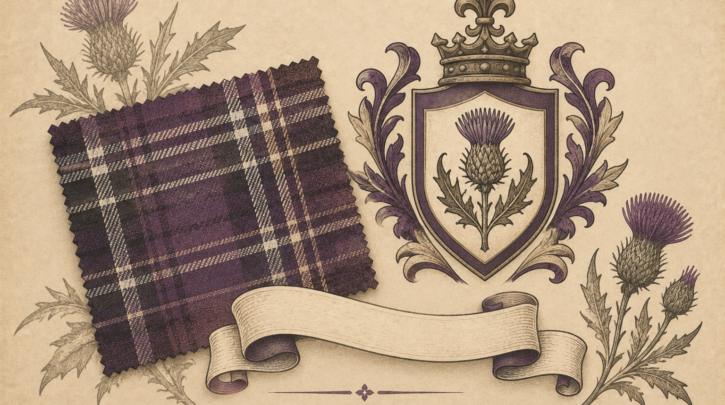
Nothing symbolises Scotland like tartan—and nothing is more surrounded by myth. The idea that each clan has always had its own distinct, official tartan is largely a nineteenth-century invention, a product of the romantic Highland revival rather than ancient custom. That does not make tartan meaningless—it is a beloved and living tradition—but the honest history, told in our tartans guide, is more interesting than the marketing, and worth knowing before you buy the “ancestral” cloth.
The Mac surnames
The most distinctively Scottish (and Irish) surnames begin with Mac or Mc—from the Gaelic for “son of.” MacDonald means “son of Donald,” and these names were originally patronymics that changed each generation before settling into fixed hereditary surnames. Along the way, myths accreted—such as the false idea that Mc is Irish and Mac Scottish—which we clear up in the meaning of Mac surnames.
Common surnames and their origins
Not every Scottish surname is a clan name or a Mac name. Scotland’s common surnames include patronymics (Robertson, Anderson), occupational names (Smith, Taylor), descriptive names (Brown, Reid), territorial names from places, and clan names (Campbell, Stewart)—and the mix differs between the Highlands and the Lowlands, whose naming traditions were quite distinct. Knowing which kind of name you carry is the first step to understanding it.
Want to trace your own name—honestly? Learn the method in researching your Scottish surname, and consider the clan and surname DNA projects that can test a lineage the documents can’t reach.
What your name proves—and doesn’t
The single most important honest point in all of this is that a clan surname does not, by itself, prove descent from that clan’s chief or bloodline. Because tenants and followers took the chief’s name, a MacGregor or a Campbell may descend from the clan’s core kindred—or from a tenant family who simply lived on clan land and adopted the name. This is not a disappointment but a clarification: it means your heritage is a matter for the records and, where they run out, for DNA, rather than for a surname-to-clan chart alone.
Honouring the heritage truthfully
Scottish clan and surname heritage is a wonderful inheritance—colourful, storied, and cherished by a global diaspora. It deserves to be reclaimed and enjoyed, and this site will help you do exactly that: understand your clan, find your tartan, decode your name, and connect with the living traditions of clan societies and Highland gatherings. But it deserves to be enjoyed truthfully, distinguishing the genuinely ancient from the charming Victorian embellishment, and grounding your family’s actual history in evidence. Do that, and you gain something better than a myth: the real story of your Scottish name, which is remarkable enough on its own.
Why the myths took hold
It is worth understanding why Scottish clan and surname heritage is so wrapped in invention, because it helps you navigate it. After the clan system was destroyed in the eighteenth century, the Highlands were romanticised almost in proportion to how thoroughly the real culture had been dismantled—by novelists, by a tartan-clad royal pageantry, and by a Victorian public hungry for a colourful, noble Highland past. Into that appetite stepped writers and manufacturers happy to supply ancient-sounding traditions, from fixed clan tartans to tidy sept lists mapping every surname to a clan. Much of what is now sold as timeless Scottish heritage dates from this period. None of that makes the heritage worthless—the clans and their history were real, and the revived traditions are now genuinely old and genuinely loved—but it does mean a careful researcher separates the medieval from the Victorian, and grounds any claim about their own family in evidence rather than in the romantic apparatus that grew up around Scottish identity.