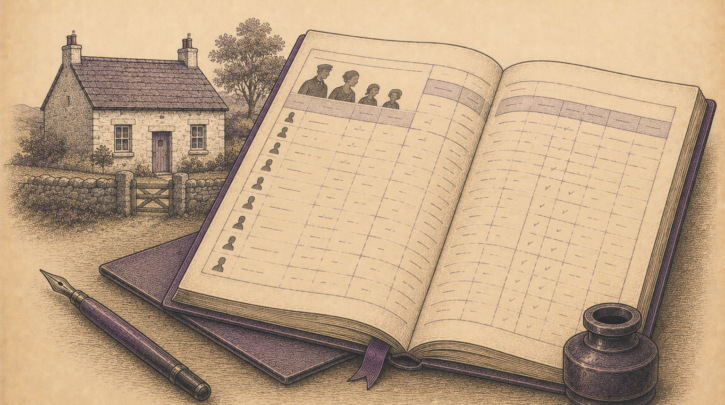

Few records place a family so vividly as the census. Taken every ten years, the Scottish censuses from 1841 to 1921 show an entire household on one night—names, ages, relationships, occupations and birthplaces—and are among the most useful and enjoyable records in Scottish genealogy. They are often the quickest way to confirm a family group and, crucially, to find the birthplace that points back to the ancestral parish. This guide explains how to use them.
What the censuses cover
A census was taken in Scotland every ten years from 1841 (with none in 1941, owing to the war). The available censuses run 1841, 1851, 1861, 1871, 1881, 1891, 1901, 1911 and 1921, the 1921 census being the most recent released. Each lists the people present in a household on census night, and together they let you follow a family across eighty years—watching children born and grow, the household change, and the family move.
Not sure where to start with your Scottish ancestry?
Get the Scottish Genealogy Quick-Start Checklist — a 5-step path to your first real ancestor record, plus the one archive that holds almost everything.
What each census reveals
The detail improved over time, and the difference matters:
- 1841 — useful but limited: names, approximate ages (often rounded), occupations, and only whether a person was born in the same county—not the exact place.
- 1851 onward — much richer: names, exact ages, relationships to the head of household, occupations, marital status, and—invaluably—the exact birthplace (parish and county).
- 1911 and 1921 — fuller still, with additional detail on families, occupations and, in 1921, employers and more.
That exact birthplace, given from 1851, is often the single most valuable clue a census provides, because it names the parish where you should look for the birth record.
The censuses are on the official ScotlandsPeople service. Learn to search them economically there, and see all the record types on the records hub.
How to use them in research
The census is a superb anchor. Find your family in one census and you have a whole household to confirm against other records; find them across several and you can track the family through time, confirm ages and relationships, and spot moves. Above all, use the birthplace column to locate where each person was born, which points you to the OPR or statutory birth record. Because relationships are stated from 1851, the census is also the easiest way to confirm who belonged to a family—essential when working with a common surname.
A few cautions
Treat census details as good evidence but not gospel. Ages can be inexact (people did not always know or admit their true age), birthplaces were sometimes given loosely, and names could be misheard or misspelled by the enumerator. Spelling of both names and places varies, so search flexibly. And a census is a single night’s snapshot—someone away that night simply will not appear. Cross-check what you find against the vital records, and the census becomes one of your most powerful tools for reconstructing a Scottish family and tracing it back to its parish of origin.
Following a family across the censuses
The real power of the census emerges when you use several together. By finding your family in successive censuses—1851, 1861, 1871 and on—you can watch the household evolve: children appearing and then leaving, ages advancing (roughly) in step, occupations changing, the family perhaps moving from one parish to another. This longitudinal view confirms relationships, reveals births and deaths between censuses, and exposes moves that you can then trace in the vital records. A single census is a snapshot; a run of them is a time-lapse of your family’s life across the decades.
Cross-referencing the censuses with the statutory records is especially productive. A child appearing in an 1861 census points to a birth to find; a spouse vanishing between censuses suggests a death; a new surname for a daughter hints at a marriage. Each census raises questions the vital records answer, and each vital record you find can be checked against the census household. Worked in tandem, the two sources reconstruct a family with a completeness and confidence that neither achieves alone.
The 1921 census and what’s missing
The most recent Scottish census open to researchers is 1921, released relatively recently and rich in detail. Two later gaps are worth knowing: there was no census in 1941 because of the Second World War, and Scotland has no equivalent of the 1939 register taken in England and Wales, so the interwar and wartime decades are thinner for census purposes. For those years you lean more on the statutory records and other sources. For everything up to 1921, though, the censuses remain one of the most useful and revealing resources in Scottish genealogy, and often the fastest route to the parish you need.