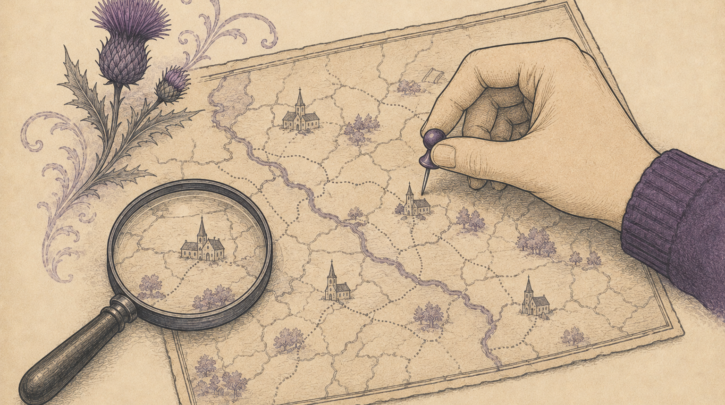

Scottish records are organised by place—by parish before 1855 and by registration district after—so to find your family you generally need to know where in Scotland they came from. “Somewhere in Scotland” is rarely enough. The good news is that the clue is usually recoverable, most often from the records your ancestor left after emigrating or from a census birthplace. This guide shows you where to look.
Why the place matters
Scotland has no single search that returns a birth by name across the whole country for free; the records are arranged by parish and district, and even the official ScotlandsPeople searches work best when you can narrow by place. Identifying the parish (or the post-1855 district) is therefore the prerequisite for efficient research—the key that turns a broad, costly search into a precise one.
Not sure where to start with your Scottish ancestry?
Get the Scottish Genealogy Quick-Start Checklist — a 5-step path to your first real ancestor record, plus the one archive that holds almost everything.
The best sources
Look first to the records your ancestor generated after leaving Scotland, and to the census, which so often names the exact birthplace:
- The census birthplace — if your family appears in a Scottish census from 1851 on, it names the exact parish of birth; even for emigrants, a census taken before they left can pinpoint origins.
- Emigration and destination records — passenger lists, and the records your ancestor created abroad (see finding your Scottish emigrant ancestor), which may name the Scottish birthplace.
- Vital records abroad — marriage and death records in the new country that state a Scottish place of birth.
- Church records abroad — congregations that recorded members’ origins.
Mind the spelling and the county
Scottish place names were often mangled by clerks abroad, or confused with a nearby town or the county. A parish name may appear in several spellings, so sound it out and cross-reference. Knowing the county narrows the search considerably, since parish names can recur; pairing a parish name with its county usually pins it down. Gazetteers and parish lists help you confirm a candidate and locate it precisely.
Found the parish? The records open up. Head to the records hub and the ScotlandsPeople guide to start searching economically.
When the trail is vague
If the paper trail only gets you to a county or region, a few more techniques help. Chain migration meant Scots from one area often settled together abroad, so identifying where your ancestor’s neighbours came from can reveal the shared origin. DNA matches who know their parish can point the way—see DNA testing. And a distinctive surname, especially a Highland or clan name associated with a particular district, can narrow the search. Finding the parish takes patience, but it is the highest-value work in Scottish genealogy, because nearly everything else depends on it.
Confirming a candidate parish
When you have a likely parish, confirm it before investing time and ScotlandsPeople credits in its records. Look for your family there—the expected birth, the parents’ names, the ages that match—in the census or the vital records, and check that the details agree with what you already know. Finding them, with the facts aligning, is the confirmation that you have the right parish and not a same-named one elsewhere in Scotland. This quick check, made before deep research, saves both wasted effort and wasted credits, and marks the real beginning of your work in the Scottish records.
Be alert, too, to the difference between the pre-1855 parish and the post-1855 registration district, whose boundaries do not always match. For research spanning the 1855 divide, you may need to know both the civil registration district and the older ecclesiastical parish for the same place. Reference works and the ScotlandsPeople place lists help you align them, so that you can follow a family smoothly from the statutory records into the old parish registers without losing them at the boundary.
Why this is the highest-value work
It is worth stressing how much rests on finding the place. Almost every later step—searching the registers, the census, the kirk session records—depends on knowing where to look, and in a pay-per-view system, searching without a place is both harder and more expensive. Time spent identifying the parish is therefore the best-invested time in all of Scottish genealogy: it converts a vague, costly, nationwide hunt into a precise and economical search of one place’s records. Get the parish, and the whole of that community’s recorded past—often reaching back centuries—opens to you.