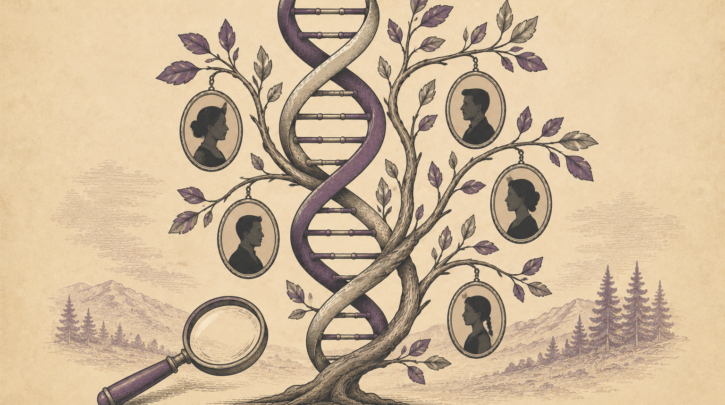

A DNA test can do two genuinely useful things for a Scottish family history: connect you with living relatives—sometimes cousins still in Scotland—and confirm the lines you have traced on paper. What it will not do is name your parish or build your tree; for Scottish ancestry, the records do the building and DNA does the confirming. Scotland also has a distinctive DNA angle found almost nowhere else: the clan and surname Y-DNA projects. This guide compares the tests and tells you which to buy first, and for what.
Disclosure: this article contains affiliate links to MyHeritage. If you buy a DNA kit or start a trial through them, we may earn a commission at no extra cost to you. We do not earn commissions from AncestryDNA or the other companies mentioned. See our affiliate disclosure.
The one-minute answer
For most people with Scottish ancestry, MyHeritage and AncestryDNA are the two to consider first. MyHeritage is stronger in Europe, but stopped accepting uploads from other companies in August 2025, so its pool is reached only by taking a MyHeritage test. AncestryDNA has the largest database, which is ideal for finding cousins across the heavily-tested Scottish diaspora in North America and Australasia, so being in both pools means taking a test with each. For the distinctively Scottish work of testing a clan or surname line, FamilyTreeDNA and its Y-DNA projects are the specialist choice—and one of the best reasons to test at all if you carry a Scottish surname.
Ready to test? Our recommended kits and current discounts are on the Scottish DNA hub. New to it all? This guide and the hub together will get you started.
What an autosomal test measures
MyHeritage, AncestryDNA and 23andMe all sell the same type of test: an autosomal test, reading markers across the chromosomes you inherit from both parents. Because you receive roughly half of each parent’s DNA, the test reaches back reliably about five to seven generations—to your fourth or fifth great-grandparents—before the DNA from any single ancestor becomes too small to detect. That reach is excellent for confirming relationships in the 1800s, the era Scotland’s detailed statutory records also cover, but it cannot by itself prove a connection to a distant ancestor of the 1600s—for that you still need the documents, or, for a single surname line, a Y-DNA test.
MyHeritage: European reach
MyHeritage is the strongest of the mainstream tests for reaching relatives who stayed in Europe, and it has features that make it especially worth using alongside Ancestry: it draws on a different pool of testers (you reach it by taking a MyHeritage test, since it stopped accepting uploads in August 2025), and it includes a chromosome browser for segment analysis that Ancestry lacks. For Scottish research its European reach is a modest bonus—most of the Scottish diaspora it will help you find is in the anglophone world, where Ancestry also excels—but the different pool and the extra tools make it a natural complement.
MyHeritage also offers two optional extras. DNA Traits is a set of recreational reports on everyday characteristics, unlocked for a one-time fee per kit. DNA 360° is a separate kit that adds health and wellness reports to your ancestry results; it is for informational purposes only, is not a diagnostic test, and is currently sold only to adults in the United States and United Kingdom. Check MyHeritage for what is included (affiliate link).
DNA test
Ready to try a MyHeritage DNA test?
See what a MyHeritage DNA test includes, from ethnicity estimates to DNA matches with relatives who have tested too.
AncestryDNA: the biggest database
AncestryDNA’s advantage is sheer scale, which matters most when your goal is finding relatives across the diaspora—the descendants of Scottish emigrants scattered across the United States, Canada, Australia and New Zealand, all countries where DNA testing is popular. Its match database is the largest in the industry, its tree integration is strong, and its ThruLines feature suggests how matches connect through shared ancestors. Its limitations are that it offers no Y-DNA or mtDNA testing and no chromosome browser, so detailed segment analysis must be done elsewhere—but for finding cousins, it is unmatched.
23andMe: health focus, and a caution
23andMe leads in health-and-trait reporting, but for Scottish genealogy it is usually the weakest of the three: no tree-building, no record integration, and a smaller matching database. You would choose it mainly for the health reports rather than the ancestry.
Worth knowing before you buy: 23andMe filed for Chapter 11 bankruptcy in 2025. A nonprofit founded by its former CEO, the TTAM Research Institute, acquired its assets and it now operates as a nonprofit, but the episode drew lawsuits over genetic-data privacy and legal scrutiny has continued. Your results would not be wrong, but if long-term custody of your genetic data matters to you, read the current privacy terms and know you can request deletion.
FamilyTreeDNA: the Scottish specialist
For Scottish ancestry, FamilyTreeDNA deserves special attention, because it alone offers Y-DNA testing—which follows the strict paternal line, the same line a surname follows—and it hosts the clan and surname DNA projects that are a particular glory of Scottish genetic genealogy. If your interest is a specific Mac name or clan line, or testing whether you descend from a clan’s kindred rather than merely sharing its name, Y-DNA and these projects can answer what autosomal DNA cannot. This is the test that makes Scottish DNA distinctive, and for surname questions it is the one to buy.
Match your test to your goal
- Segment analysis and European matches: MyHeritage, with its chromosome browser.
- A specific surname or clan line: FamilyTreeDNA Y-DNA and the relevant clan or surname project.
- Diaspora cousins and the biggest database: AncestryDNA, then add a MyHeritage test to widen your reach.
- Health and traits, ancestry as a bonus: 23andMe—after reading the privacy note above.
Free trial
Ready to put your research into a family tree?
Start a free MyHeritage trial to build your tree online and search historical records and other family trees as you add each generation.
The honest bottom line
DNA is a powerful confirmation tool and a way to meet living cousins, and—through the clan and surname projects—a genuinely special resource for Scottish surname research. But it is the records that build and prove a Scottish tree, and you should read ethnicity estimates, in particular, with real caution: as we explain in Scottish DNA ethnicity results, they struggle to tell the peoples of the British Isles apart. Test to find relatives and to confirm your lines; rely on the documents to know. And note one thing clearly: for citizenship, DNA carries no weight whatsoever—a point we return to in connecting DNA to your Scottish records.
Start on the Scottish DNA hub for kit links, then learn to fold results into a documented tree in connecting DNA to your Scottish records.