
No surnames are more distinctively Scottish—and Irish—than those beginning with Mac or Mc. MacDonald, MacGregor, Mackenzie, McLeod: these names carry the romance of the Highlands and the clans. But what do they actually mean, where did they come from, and is there really a difference between Mac and Mc? This guide explains the true meaning and origin of Mac surnames, clears up the myths, and shows how to research one.
Mac means ‘son of’
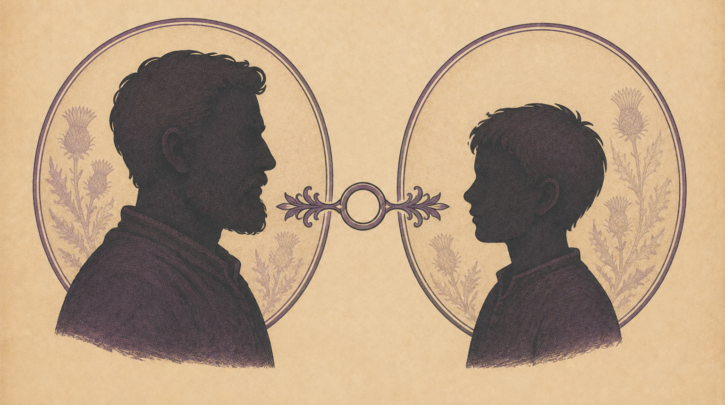
The meaning is simple and ancient: Mac is the Gaelic word for “son,” so a Mac surname originally meant “son of” whoever followed. MacDonald means “son of Donald,” MacGregor “son of Gregor,” Mackenzie “son of Kenneth” (from the Gaelic form). The name that followed Mac was usually a personal name—the father’s or an ancestor’s—so these surnames began as patronymics, identifying a person by their father, exactly as the Scandinavian -son names did. This is the key to understanding them: a Mac name points back to a founding ancestor whose given name it preserves.
Not sure where to start with your Scottish ancestry?
Get the Scottish Genealogy Quick-Start Checklist — a 5-step path to your first real ancestor record, plus the one archive that holds almost everything.
The Mc-versus-Mac myth
Let us dispose of the most persistent myth at once: there is no meaningful difference between Mac and Mc. Both are simply forms of the same Gaelic word for “son.” Mc is merely a contraction of Mac (sometimes written M’ historically), and the choice between them was a matter of scribal habit, spelling fashion and inconsistency, not nationality or religion. The widespread belief that Mc indicates Irish (or Catholic) origin and Mac Scottish (or Protestant) is entirely false—a myth with no historical basis. Both forms appear across both Scotland and Ireland, often for the very same family in different documents, so never draw conclusions about origin from which spelling a record happens to use.
From patronymic to fixed surname
Like patronymics everywhere, Mac names began by changing every generation: the son of Donald MacGregor might himself be recorded as a “Mac” of Donald’s own father, or as MacDonald, depending on the naming practice of the time and place. Over time—and tied up with the rise of the clans, whose names became badges of identity and allegiance—these patronymics froze into fixed, hereditary surnames, passing unchanged from generation to generation. So a modern MacGregor no longer means literally “son of Gregor” but marks membership in, or association with, the line and clan that took that name. A related form, Nic (“daughter of”), occasionally appears for women in older Gaelic records, though it did not generally survive as a fixed surname.
A Mac name is ideal for lineage testing, since it follows the male line. Explore the clan and surname DNA projects and learn the method in researching your Scottish surname.
Mac names and the clans
Many—though not all—Mac names are clan names, and the connection is central to Highland identity. But the honest caution from the clan system applies here in full: bearing a Mac clan name does not prove descent from the clan’s chief or founding kindred, because tenants and followers took the clan’s name too. Your MacDonald ancestors may descend from the clan’s core line—or from a family who lived on MacDonald land and adopted the name. Which is true for your family is a question for the records and, often, for DNA, not for the name alone.
Researching a Mac surname
A Mac surname offers both a challenge and an opportunity for the researcher. The challenge is that popular Mac names can be very common and were spelled with endless variation—Mac or Mc, with the following letter capitalised or not, and the root name spelled several ways—so you must search flexibly and reconstruct whole families rather than trusting a single spelling. The opportunity is that, because a Mac name follows the male line from a founding ancestor, it is ideally suited to Y-DNA testing and the clan and surname projects that are a particular strength of Scottish genetic genealogy. Combine the documentary records with, where the paper trail runs out, a Y-DNA test, and a Mac surname can be traced with a depth and confidence that neither approach achieves alone.