
No episode in Scottish history casts a longer shadow over the diaspora than the Highland Clearances—the removal, over roughly a century, of Highland tenants from the land their families had worked for generations. For countless descendants of Scottish emigrants, the Clearances are the reason their ancestors left, and understanding them is to understand why so much of the Highlands emptied and so many Highlanders ended up in Canada, America and beyond. This guide explains what happened and what it means for your family history.
After Culloden: the end of the old order
The Clearances grew from the destruction of the traditional Highland way of life. The defeat of the Jacobite rising at Culloden in 1746 was followed by a determined effort to break the clan system: the powers of the chiefs were curtailed, Highland dress and weapons were banned for a time, and the old bonds between chief and people were severed. Over the following decades, clan chiefs were transformed from patriarchs of their people into commercial landlords—and many came to see the tenants who had once been their followers as an obstacle to profit.
Not sure where to start with your Scottish ancestry?
Get the Scottish Genealogy Quick-Start Checklist — a 5-step path to your first real ancestor record, plus the one archive that holds almost everything.
Sheep, and the removal of the people
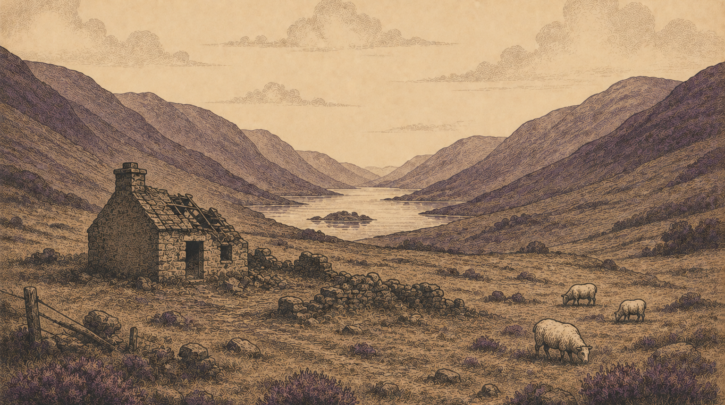
The economics were brutal in their logic. Large-scale sheep farming promised landlords far greater returns than the rents of small tenant farmers, and so, from the later 1700s and especially in the early-to-mid 1800s, tenants were cleared from the inland straths and glens to make way for sheep. Some were moved to poor coastal crofts or barren land; many were pressured or forced to emigrate. The evictions could be harsh and, at their worst, brutal—townships burned to prevent return, families turned out with little—and they broke a centuries-old connection between the Highland people and their land.
Famine and the second wave
The disaster deepened in the 1840s, when the Highland potato famine—the same blight that devastated Ireland—struck a population already impoverished and displaced. Destitution spread, and a further wave of emigration followed, some of it sponsored by landlords eager to be rid of tenants who could no longer pay rent or feed themselves. “Assisted” emigration schemes shipped many of the famine-stricken to Canada and Australia, blurring the line between relief and expulsion.
If your family was cleared from the Highlands, their trail often leads to Canada or Australia. Trace it with finding your emigrant ancestor and the records hub.
Where the cleared people went
The emigrants of the Clearances scattered widely, but certain destinations drew them especially. Many Highlanders went to Canada—to Nova Scotia and Cape Breton, to Prince Edward Island, to Glengarry in Ontario—where in places the Gaelic language and Highland culture survived for generations. Others went to Australia, to the Carolinas in America, and elsewhere. Whole communities were transplanted, so that the culture cleared from a Highland glen sometimes lived on more strongly in a Canadian settlement than in the emptied homeland.
The legacy, and your family
The Highland Clearances left a deep and lasting wound in the Scottish consciousness, mourned in song and story and remembered keenly by the diaspora. For the family historian, they are often the explanation for an ancestor’s departure and a poignant part of the family story—a reminder that emigration was, for many Highlanders, not opportunity but exile. Recovering that story, and tracing your cleared ancestors back to the glen they were forced to leave, honours a history that its people were long denied the power to record themselves—and connects you to one of the most moving chapters in Scotland’s past. Understanding whether your roots lie in the cleared Highlands also shapes where you look for records and how you read your family’s emigration.
Reading the Clearances honestly
The Clearances are emotionally charged, and it is worth approaching them with both sympathy and care. They were, for many Highlanders, a genuine trauma—evictions, lost homes, forced departures—and the grief and anger they caused are woven into Highland song, story and diaspora memory to this day. At the same time, the history was complex: the pace and severity varied greatly by estate and region, some emigration was voluntary or semi-voluntary even amid the pressure, and the picture of universal, uniform brutality is a simplification. For the family historian, the point is not to adjudicate the history but to understand that if your ancestors came from the Highlands in this period, their emigration likely sat somewhere on a spectrum from outright expulsion to constrained choice—and that recovering their particular story from the records is how you learn where on that spectrum they actually stood.