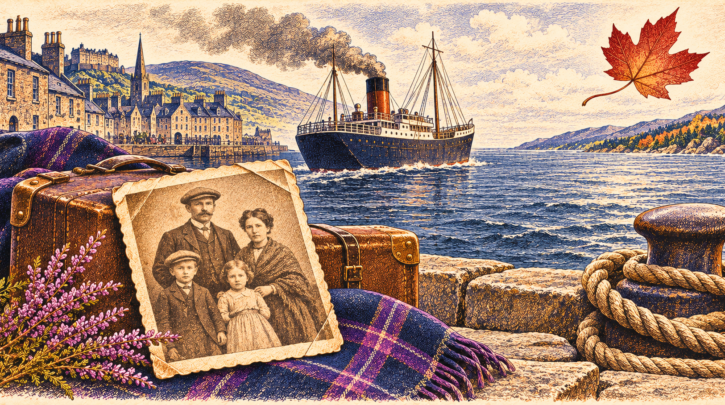

Scots have been settling in Canada for more than two centuries, from the Highlanders who crossed to Nova Scotia and Cape Breton to the farmers and tradespeople of the Prairies and Ontario. If your Scottish ancestors went to Canada, and your family later moved on to the United States, you may have a Canadian citizenship claim that has nothing to do with Scotland. Under a Canadian law that changed in December 2025, descendants born abroad before that date may be able to claim through a Canadian citizen ancestor. This guide explains how that works and where Scottish families should look.
Important: This article is general information for educational purposes, not legal advice. British nationality and immigration law is complex and fact-specific, the rules and fees change, and the position described here is current as of October 2026. Always verify your situation with the UK Home Office (GOV.UK) and consider consulting a qualified immigration adviser before acting.
Why Canada, not Scotland
British citizenship by descent usually stops after one generation born abroad, which is why the Scottish route is so narrow (see the honest truth about Scottish citizenship by descent). Canada’s rules are different. For people born abroad before 15 December 2025, Canada removed its first-generation limit, so citizenship can pass through more than one generation born outside Canada, as long as the chain traces to a Canadian citizen ancestor. That makes a Scottish family’s Canadian chapter potentially more valuable than its Scottish one. If you are weighing both countries, see how to get a first British passport when born abroad to check the British side as well.
Citizenship did not exist before 1947
Canadian citizenship became a separate legal status on 1 January 1947. Before then, people in Canada were British subjects. That matters for Scottish immigrants, who were British subjects in Scotland and remained so in Canada. Commentators say that British subjects who had lived in Canada long enough before 1947 may be treated as Canadian citizens from that date, and later laws extended recognition to more people. Whether a particular Scottish ancestor counts depends on when they arrived, how long they lived in Canada and whether they later left, so the dates matter. Our guide to Scottish emigration to Canada explains the waves of migration and where to look.
Not sure where to start with your Scottish ancestry?
Get the Scottish Genealogy Quick-Start Checklist — a 5-step path to your first real ancestor record, plus the one archive that holds almost everything.
How to check your own line
- Identify the Canadian branch. Which ancestor lived in Canada, and when? Work forward from there.
- Check each parent and child link. A Canadian citizen has to be a parent of the next person in the chain at the time of birth.
- Note when each person left Canada, if they did, and whether they became a US citizen and when.
- Look for the records: Canadian birth and baptism records, naturalisation or immigration files, census entries and ship lists. Our guide to finding your Scottish emigrant ancestor shows how to follow the trail across the Atlantic.
Searching for the records? A free MyHeritage trial lets you search historical records and family trees for clues (affiliate link).
What you would actually apply for
If you qualify, you do not apply to become a Canadian citizen. You apply for a citizenship certificate, which is the official proof, and which can then support a passport application. Commentators report that the descent route involves no language test, no residence requirement and no oath. The claim depends entirely on whether a parent in your line was a Canadian citizen, and on documents that prove each link, which Canadian officials expect to be traceable to official sources. Much of the commentary on this law comes from immigration firms and trade publications, so confirm any claim against the Government of Canada’s official citizenship pages.
The Scottish records that help
The same Scottish records that trace your family in Scotland help establish who your Canadian-bound ancestor was. Birth, marriage and death records from Scottish statutory registers and Old Parish Registers link a Canadian settler to a Scottish family, and the ScotlandsPeople guide explains how to search them. Name variants matter on both sides of the Atlantic, so our guide to Scottish naming patterns will help you recognise the same person in different records.
Wondering where you stand? Start with our honest citizenship guide, then check the routes in who actually qualifies for British citizenship, and gather evidence with the research guide.
Scots-Irish and Highland lines
Families whose ancestors were Scots-Irish, that is, Ulster Scots who went to North America in the eighteenth century, have a different picture, because many settled in the American colonies rather than in what is now Canada (see the Scots-Irish). Highland families displaced by the clearances often settled in Nova Scotia and Cape Breton, which makes them more likely to have a Canadian branch (see the Highland Clearances). Neither fact proves a claim. It tells you where to look first.
Next steps
- Ask relatives which branch of the family, if any, lived in Canada.
- Build a one-page timeline of each ancestor’s birth, emigration and any naturalisation.
- Compare what you find with the official Canadian guidance, and take a complicated case to a licensed Canadian immigration lawyer or consultant.
- If instead you hope to live in Scotland, see UK visa options for Americans.
Whatever the outcome, the research is rarely wasted. It adds a new branch to your tree, as the Scottish diaspora shows.