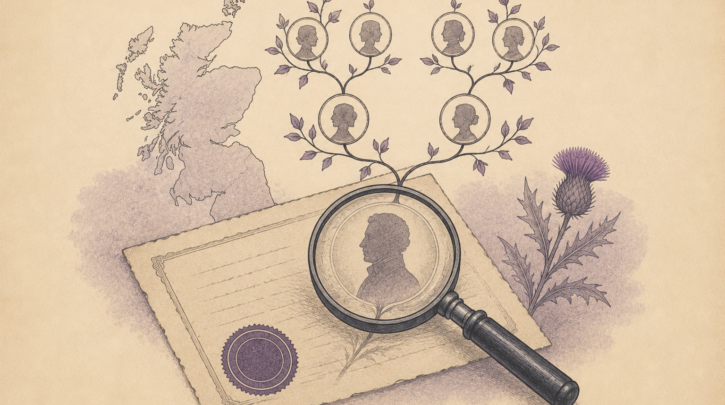

Scottish ancestry is among the most rewarding in the world to trace. Scotland kept unusually detailed records—its civil registration, begun in 1855, records more than almost any other country’s, and before that the parish registers reach back centuries—and nearly all of it is gathered on a single official website. With patience and a clear method, most Scottish families can be followed well into the 1700s, and often earlier. This guide lays out the whole journey, from your living room to a parish register written three centuries ago.
Two features shape Scottish research and are worth fixing in mind at the outset. First, there is a great divide at 1855: from that year, detailed statutory records of births, marriages and deaths exist; before it, you rely on the old parish registers of the Church of Scotland, which are patchier. Second, nearly everything lives on ScotlandsPeople, the official pay-per-view service—so a little strategy saves money. We will guide you through both.
Step 1: Start at home
Before you touch a Scottish record, mine your own family. The most important early facts are usually closer than you think—in documents, relatives’ memories, and the backs of photographs. Gather what you can:
- Names in full, including women’s maiden surnames—a Scottish strength, since maiden names appear throughout the records.
- The place of origin in Scotland—ideally the parish or town, the single most useful fact to establish.
- Approximate dates for birth, emigration, marriage and death, to anchor the search.
- The county or region, and any hint of religion, which matters for which registers to search.
Step 2: Find the ancestral parish
If you do not yet know where in Scotland your family came from, finding it is your first real task, because the records are organised by parish and registration district. The best clues usually come from the records your ancestor generated after emigrating—which we cover in finding your Scottish emigrant ancestor. Establish the place, and Scotland’s superb records open before you.
Not sure where to start with your Scottish ancestry?
Get the Scottish Genealogy Quick-Start Checklist — a 5-step path to your first real ancestor record, plus the one archive that holds almost everything.
Step 3: Work back through the statutory records (from 1855)
From 1855, Scotland’s statutory records of births, marriages and deaths are your workhorse—and they are gloriously detailed. A Scottish death record, for instance, typically names the deceased’s parents (including the mother’s maiden name), a richness rarely found elsewhere. Working backward from a known ancestor, each record leads to the next, until you reach the 1855 boundary.
Step 4: Cross the 1855 divide into the old parish registers
Before 1855, you move into the old parish registers (OPRs) of the Church of Scotland, which recorded baptisms, marriage banns and burials, some reaching into the 1500s. Their coverage varies by parish and they are less complete than the statutory records—burials especially are patchy—but they carry most families back well before civil registration. The kirk session records of the parish church can fill gaps and add colour.
Step 5: Use the censuses to place the family
The census records, taken every ten years from 1841 to 1921, are a superb way to see a whole household together, with ages, relationships, occupations and—from 1851—exact birthplaces. Censuses are often the quickest way to confirm a family group and to find the birthplace that points you back to the right parish.
Step 6: Learn the naming patterns and the handwriting
Two skills sharpen your research. First, the traditional Scottish naming pattern—by which children were often named after specific grandparents—can help you predict and confirm earlier generations. Second, a little practice at reading old Scottish records—the handwriting and the handful of Scots and Latin terms—makes the older registers readable.
Step 7: Build, verify, and break through walls
Work back one documented generation at a time, recording the source for every link. When you hit a wall—a gap in the OPRs, a family that left the Church of Scotland, a common surname—there is usually a way through; our guide to Scottish genealogy brick walls covers the common ones.
Why this matters beyond the tree
For many, tracing the family is an end in itself. For others it is the first step toward a heritage trip to the ancestral parish or clan country, a look at the clan and surname behind the name, or simply a deeper connection to the world of the emigration that carried the family across the sea. Whatever your goal, the path starts here—with the place and the records—and Scotland’s records will carry you a very long way.
How far back can you realistically go?
A reasonable expectation for a well-documented Scottish family is the 1700s through the parish registers, and sometimes into the 1600s where a parish’s OPRs survive that early. This is deep by international standards, helped by the detail of the statutory records after 1855 and by Scotland’s long tradition of parish record-keeping. How far your lines reach depends on when your parishes’ registers begin, how well they survived, and whether your family stayed within the Church of Scotland—dissenting families can be harder to follow, as our brick walls guide explains.
It also helps to set the right goal. If you simply want to know your origins and build a tree, Scotland’s records will take you a long way with patience. If you are hoping the research leads to citizenship, be aware in advance that Scottish (British) ancestry generally does not confer a citizenship claim beyond one generation born abroad—the genealogy is deeply rewarding regardless, but it is best to understand the reality before pinning hopes on it.
Common mistakes to avoid
A few errors trip up beginners repeatedly: spending ScotlandsPeople credits before confirming the right record; assuming a family must be in the OPRs when they belonged to another church; treating the traditional naming pattern as a rule rather than a hint; and giving up at the 1855 divide instead of harvesting the parents’ names the last statutory records provide. Avoid those, work one documented generation at a time, and Scottish genealogy becomes not just possible but deeply satisfying.