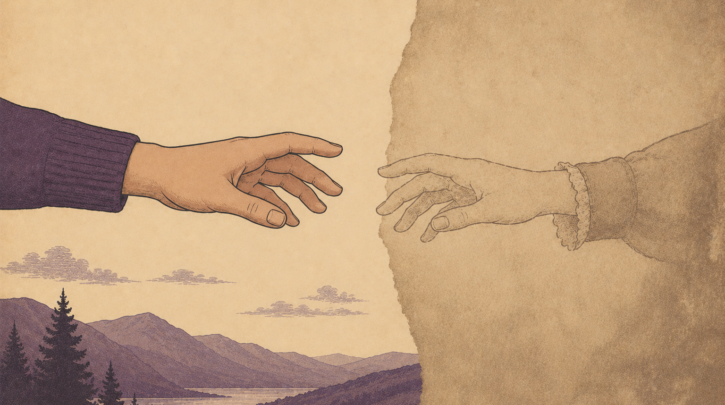

For many people—especially the descendants of emigrants whose families set aside the old ways over the generations—genealogy is the beginning of something larger. Tracing the tree answers who your ancestors were; reclaiming your heritage is about carrying something of what they were into your own life. This is a guide to that fuller journey: from records to clan and tartan, Burns and ceilidh, Gaelic and Highland games, and living connection—and the freeing truth, which this whole site has argued, that none of it requires a passport.
Start with the records—but don’t stop there
The foundation is knowing your family. Trace your line as far as Scotland’s excellent records allow, using the records hub and the methods in our guide to tracing Scottish ancestry. But a tree on a screen is not yet a reclaimed heritage—the names become meaningful when you learn what their lives were like: the clan they belonged to, the parish and region they came from, the world of the Clearances or the Lowland towns, the emigration that carried them away. Let the documented facts open onto the living culture behind them.
Not sure where to start with your Scottish ancestry?
Get the Scottish Genealogy Quick-Start Checklist — a 5-step path to your first real ancestor record, plus the one archive that holds almost everything.
Reclaim the clan and the tartan
For those with Highland roots, the clan is a natural focus of reclamation—understanding your clan’s history and country, connecting with its society, perhaps wearing its tartan. Do this with the honest understanding this site has urged: clan and tartan traditions are wonderful and worth embracing, but much of the fixed clan-tartan system is a nineteenth-century creation, and a clan surname does not by itself prove chiefly descent. None of that diminishes the heritage; it simply lets you reclaim it truthfully—wearing your tartan and honouring your clan while knowing the real story, which is richer than the myth.
A note for those who arrived hoping for a passport: as our honest citizenship guide explains, most descendants of Scottish emigrants do not qualify for British citizenship, and Scottish heritage confers no citizenship by itself. But that does not diminish the heritage in the least. You reclaim these traditions not for a document, but for the connection itself—which is reason enough, and which no rule of nationality law can touch.
Reclaim the traditions
Scottish culture is rich in living traditions that anyone of Scottish heritage can take up and enjoy:
- Burns — the poetry of Robert Burns, celebrated worldwide each January at a Burns Supper with haggis, whisky, and the reciting of his verse; a warm and accessible entry into Scottish culture.
- The ceilidh — the traditional social gathering of Scottish music and dance, joyful and welcoming to beginners.
- Highland games and pipes — the athletics, piping and dancing of the games, held across Scotland and the diaspora, and the unmistakable sound of the bagpipes.
- The table — haggis, shortbread, Scotch whisky and more, and the conviviality that goes with them; and observances such as St Andrew’s Day and Hogmanay.
Reclaim the language
Language is a deep form of reclamation, and Scotland offers two threads. Scottish Gaelic—the language of the Highlands and Islands, once spoken by many of the emigrant ancestors—is a minority language today but the subject of a real revival, with learning resources for those drawn to it; even a little Gaelic connects you to the Highland heritage in a special way. Scots—the language of Burns and much of the Lowlands—is another rich strand of the heritage. You need not aim for fluency; even a foothold in the words of your ancestors is a moving connection to their world.
Find the living branches of your family, too: choose a test on the DNA hub and learn to turn matches into real connections with our records workflow.
Reclaim the connections—and pass them on
Heritage is ultimately people. A DNA test can connect you with living cousins in Scotland and across the diaspora; clan societies welcome descendants worldwide; and a heritage trip can turn the whole endeavour from research into relationship. The deepest reclamation of all is transmission—sharing the documented tree with your children and cousins, keeping Burns Night or a ceilidh with the next generation, teaching them whose traditions these are, bringing a young relative to the ancestral glen. A family history is only as alive as its newest keeper.
Heritage without a passport
Let this be the honest and genuinely freeing conclusion of the whole journey. Most descendants of Scottish emigrants cannot claim a British passport—but your Scottish heritage does not depend on one. The records reaching back to the 1700s, the clan and its country, the cousins to find, the parish to visit, the tartan, the language, the games and the songs—all of these are yours, fully and freely, citizenship or no citizenship. Where the citizenship answer is usually no, the heritage answer, for everyone with Scottish roots, is an unqualified yes. That is the better inheritance, and it asks nothing of you but curiosity—so begin with the records, and let them lead you home.