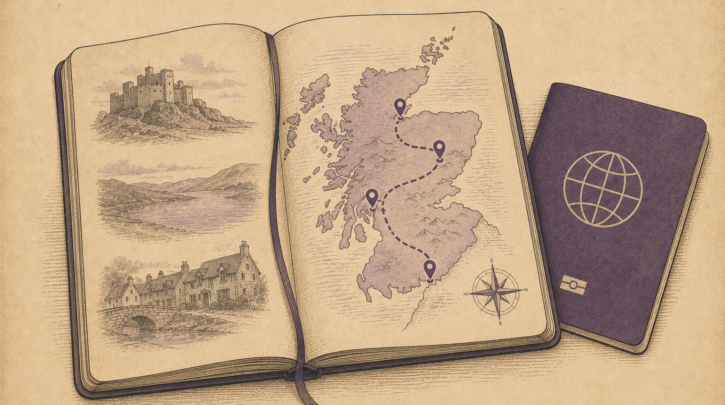

There is a moment in many family-history journeys when the names on the screen are no longer enough—when you want to stand in the parish your great-grandparents knew, see the church where they were baptised, walk the glen your clan came from before the Clearances scattered them. A Scottish heritage trip turns generations of records into something you can touch. This guide will help you plan one that is genuinely yours—not a generic tour of Edinburgh Castle, but a journey to your family’s parish, region and clan country.
In Scotland, such a trip has two hearts: the parish where your ancestors’ lives were recorded, and—for those with Highland roots—the clan country your family’s name belongs to. Planning a Scottish roots trip means identifying both, and building a journey around the real places your family came from.
Not sure where to start with your Scottish ancestry?
Get the Scottish Genealogy Quick-Start Checklist — a 5-step path to your first real ancestor record, plus the one archive that holds almost everything.
Step one: do the genealogy first
Before you book anything, identify the exact place your family came from. A heritage trip built on “somewhere in Scotland” is just a holiday; a trip built on “the parish of X in Perthshire, where my great-grandparents married in 1861” is a pilgrimage. Because Scottish records—and Scottish identity—are organised around the parish and the region, finding your ancestral parish is the essential first task, and our guide to finding your emigrant ancestor shows how to trace it from the records your family left abroad.
The whole trip begins with the parish. Identify it using the records—see the records hub—and consider testing beforehand so you can meet living cousins on the journey.
Step two: research the place before you go
Once you know the parish, learn everything you can before you travel. Find it on a map, read its history, identify the church and the churchyard, and—if possible—make contact in advance with the parish, a local heritage society, or relatives. Doing the records research first, much of it on ScotlandsPeople, means you arrive knowing exactly which ancestors were born, married and buried there, and when—so that standing in the church or churchyard, you are meeting documented people, not abstractions. Our guide to visiting your ancestral parish covers this in detail.
Step three: explore your clan country
If your roots are Highland, your trip has an extra dimension: the clan country your name belongs to. The glens, castles and lands associated with your clan, the clan’s visitor centre or museum, and—if your timing is lucky—a clan gathering or Highland games can make your heritage vivid in a way no record can. As our clan-travel guide explains honestly, visiting clan country is deeply meaningful whether or not you descend from the chief’s own line—it is the country your family’s name and story belong to.
Step four: connect with relatives and societies
One of the most rewarding parts of a Scottish heritage trip is human connection. Many families still have relatives in Scotland, and because Scots and the diaspora test DNA in large numbers, a test taken before the trip can connect you with cousins who may welcome you and show you the family’s places. Clan societies, too, often warmly receive returning descendants and can point you to clan sites and events. Reaching out ahead of time—easy in an English-speaking country—can turn a visit from sightseeing into a genuine homecoming.
Practical planning
A few practicalities make a Scottish heritage trip smoother. Scotland is easy to travel in—good roads and rail, and English (and often Gaelic in the Highlands and Islands) widely spoken. The right to roam, enshrined in Scottish access law, lets you walk the countryside and glens freely and responsibly, which is wonderful for exploring ancestral land. Summer brings long days and the season of Highland games and gatherings, though also the crowds; late spring and early autumn are quieter. Contact any parish, archive or society ahead if you hope to see specific places or records, and consider basing yourself in a regional town and driving out to the rural parishes and glens where so many families originated.
Make it personal
The best heritage trips connect you to your own people and places. Visit the church where your ancestors were baptised and the churchyard where the family names are carved in stone; walk the land they worked before the great migration carried them away; stand in your clan’s glen; share a meal with cousins or a clan society. Carry a copy of your traced line so that, standing in the parish, you know exactly who lived there and when. This, in the end, is what the whole journey through the records was leading toward—and it is often the first step in fully reclaiming a Scottish heritage that emigration set aside generations ago.
Ready to build your trip around your own family? Start with finding your parish, ground every stop in the records, and see how to research on the ground in visiting your ancestral parish.