
Tartan is the most instantly recognisable symbol of Scotland, and the notion that every clan has its own ancient, official tartan is one of the most cherished beliefs in Scottish heritage. It is also, for the most part, not true—or at least, far more recent than most people imagine. This honest guide explains what tartan really is, where the idea of fixed clan tartans actually came from, and how to enjoy and choose a tartan today with your eyes open. The true story, we think, is more interesting than the myth.
What tartan is
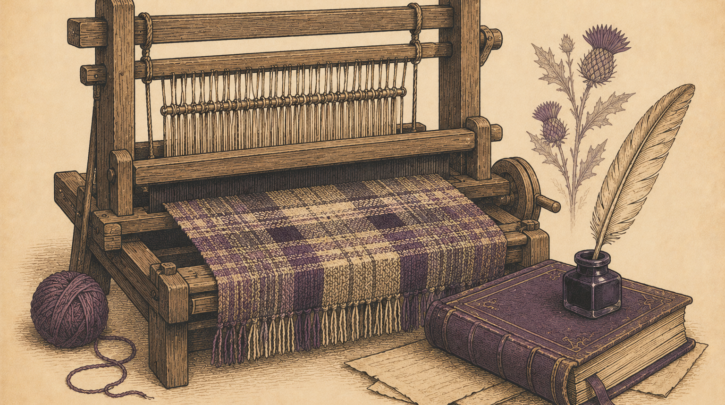
Tartan is a patterned woollen cloth woven in a specific arrangement of coloured stripes crossing at right angles—the pattern being called a sett. Tartan cloth is genuinely ancient in Scotland; Highlanders wore patterned wool for centuries, coloured with local dyes and woven by local weavers. So far, so traditional. The myth lies not in tartan itself, but in the idea that particular setts were, from ancient times, the fixed and exclusive badges of particular clans.
Not sure where to start with your Scottish ancestry?
Get the Scottish Genealogy Quick-Start Checklist — a 5-step path to your first real ancestor record, plus the one archive that holds almost everything.
The myth of the ancient clan tartan
In reality, before the nineteenth century, tartans were regional and practical rather than rigidly clan-specific. The pattern a Highlander wore depended largely on what the local weaver produced and what dyes were available in the area—so tartans had a loose regional character, but there was no system by which each clan owned a distinct, official sett that its members alone wore. People wore what they could get, and mixed patterns freely. The elaborate modern scheme, in which every clan (and many surnames) has an assigned tartan listed in registers, simply did not exist in the way the marketing implies.
The Dress Act and the interruption
The history took a sharp turn after Culloden. Following the 1745 Jacobite rising, the Dress Act of 1746 banned the wearing of Highland dress, including tartan, for much of the population—a proscription that lasted until 1782. For a generation and more, ordinary Highland tartan-wearing was suppressed, breaking the living tradition. By the time the ban was lifted, much of the old, organic tartan culture had been disrupted—which set the stage for its dramatic, and largely invented, reconstruction.
The Victorian revival—and invention
The idea of fixed clan tartans was largely created in the nineteenth century, in a wave of romantic Highland revival. Several forces drove it:
- The 1822 visit of George IV to Edinburgh, stage-managed by Sir Walter Scott as a tartan-clad pageant, which turned clan tartan into fashionable spectacle.
- The Victorian romanticisation of the Highlands, embraced by Queen Victoria and her love of Balmoral, which made all things Highland hugely fashionable.
- Published tartan ‘authorities’—notably the Vestiarium Scoticum (1842), which purported to record ancient clan tartans but was substantially fabricated—and the commercial tartan manufacturers who codified, named and marketed clan setts.
Together these created, within a few decades, the elaborate system of named clan tartans we know today—a genuinely Victorian invention dressed up as ancient tradition.
Enjoy your tartan—just know its real story. To ground your actual clan and family history in evidence, see researching your Scottish surname and the records hub.
How to choose a tartan today
None of this means you cannot or should not wear a tartan—quite the opposite. Modern clan tartans are a real, living and joyful tradition, and wearing “your” clan’s tartan is a lovely way to celebrate heritage, provided you understand it as a nineteenth-century-and-later custom rather than an ancient birthright. To find a tartan, you can look up the tartan(s) associated with your clan or surname in the modern registers, choose a district or regional tartan tied to where your family came from, or simply pick one you love. There is no wrong choice—only a more honest way of understanding what your choice means.
Truth makes the tradition richer
Understanding the real history of tartan does not spoil it; it deepens it. You can wear your clan tartan with pride, knowing it links you to a genuine tradition of Highland weaving and to the romantic revival that shaped modern Scottish identity—while not being taken in by the marketing that sells Victorian invention as ancient fact. That honesty is a gift: it lets you enjoy the colour and connection of tartan freely, ground your real family history in the records rather than a sett chart, and appreciate the fascinating, layered truth of how Scotland came to be the tartan nation the world now knows.