
Scottish immigrants shaped America from its colonial beginnings to the industrial age, and—like Scots everywhere—they tended to concentrate in particular places and communities. Knowing where Scots settled is more than historical context: because emigrants from the same part of Scotland so often ended up together, the settlement patterns are a genuine research tool for tracing your family back across the ocean. This guide maps where the Scots went in America and how that helps you.
Colonial Scottish settlement
Scots were among the earliest settlers of the American colonies, and two strands stand out. Highlanders established distinct settlements—most famously in the Cape Fear Valley of North Carolina, which drew Highland emigrants in numbers and kept Gaelic and Highland culture alive. Far larger, though, was the flood of Scots-Irish who arrived through Pennsylvania from the 1710s and spread down the frontier. These two colonial Scottish streams—Highland and Scots-Irish—planted Scottish roots across the early American landscape.
Not sure where to start with your Scottish ancestry?
Get the Scottish Genealogy Quick-Start Checklist — a 5-step path to your first real ancestor record, plus the one archive that holds almost everything.
The Appalachian frontier
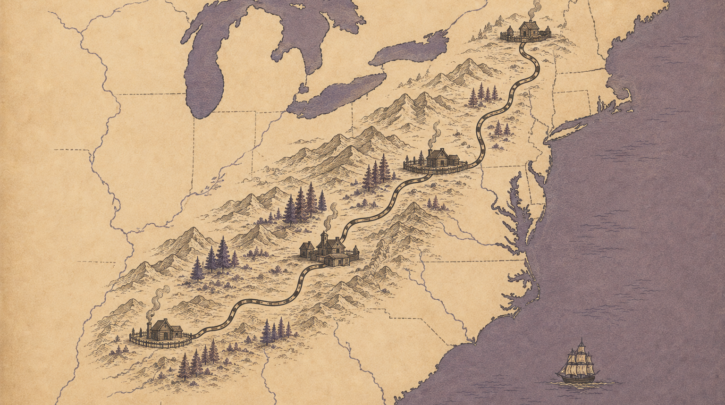
The Scots-Irish, above all, became the people of the backcountry frontier. Pushing south and west from Pennsylvania down the Great Wagon Road, they settled the Appalachian uplands—western Virginia, the Carolinas, and on into Tennessee, Kentucky and beyond. Their Presbyterian faith, their music and their fiercely independent character left a deep and lasting imprint on the culture of Appalachia and the American South, and their descendants number among the largest ancestral groups in the United States.
Later Scottish immigration
Scottish immigration continued into the nineteenth and early twentieth centuries, now shaped by industry as much as land. Skilled Scottish workers—in textiles, mining, iron and engineering—came to America’s growing industrial cities and regions, and Scots settled across the expanding nation. This later migration was more dispersed than the clustered colonial settlements, but it too followed chains of family and community, with Scots drawn to places where their kin and countrymen had gone before.
Settlement clusters can point you to the parish. Combine this with the emigration records in finding your Scottish emigrant ancestor, and search on the records hub.
Using settlement patterns in research
To put this to work, study the community your immigrant ancestor settled in. Where did the other Scots in that district come from? Which Scottish places recur in the local church records—especially Presbyterian congregations, the natural home of Scottish and Scots-Irish settlers—and among the families your ancestor married into or lived beside? Local and county histories, church records and community traditions often reveal these origins. Because Scots clustered by origin, the answer for your ancestor’s neighbours is frequently the answer for your ancestor too, making the geography of Scottish America a path back to the parish and the deep records waiting there.
Distinguishing the strands
A final, important point: to research a Scottish-American family well, you must work out which Scottish stream they belonged to, because it determines where you look. A colonial backcountry family is very likely Scots-Irish, with a trail running through Ulster; a Cape Fear Highlander leads directly to the Highlands; a nineteenth-century industrial worker leads to Lowland Scotland or the Scottish cities. Identifying the strand—from the period, the place, the religion and the family tradition—is often the key that turns a vague “Scottish” heritage into a traceable line back to a specific corner of Scotland.
Church records as the key
For Scottish and Scots-Irish America, one record type deserves special emphasis: the Presbyterian church record. Presbyterianism was the natural faith of both Lowland Scots and the Ulster Scots, and their congregations—on the frontier and in the towns—often kept registers of baptisms, marriages and membership that can identify a family, link its generations, and sometimes record a Scottish or Ulster origin. Where civil records are thin, especially in the colonial and frontier periods, the church record may be the best—or only—documentary link. Seeking out the specific congregation your ancestors belonged to, and any surviving records or published histories of it, is therefore one of the most productive steps in tracing a Scottish-American family, and a natural complement to the emigrant-ancestor method that carries the line back across the sea.