
The central challenge of Scottish diaspora genealogy is the leap across the ocean: connecting your immigrant ancestor abroad to the specific parish in Scotland where their records live. Get that place, and Scotland’s superb records open up; miss it, and the trail goes cold at the water’s edge. The good news is that the migration was well documented, and Scotland’s detailed records often make the link recoverable. This guide gives you a practical method.
Start with what the new country recorded
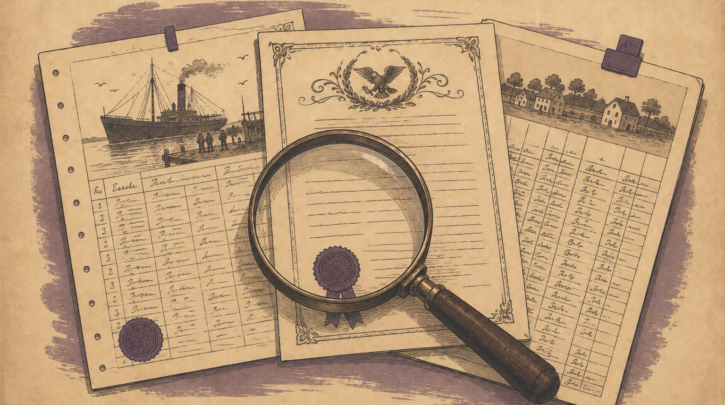
Before reaching back to Scotland, gather everything the records in your ancestor’s new country say about them, because the clue to the parish often hides there. Work through:
- The immigrant’s own records — naturalisation papers, censuses, marriage and death records, which may give a Scottish birthplace or birth date.
- Church records — especially Presbyterian congregations, which sometimes recorded members’ Scottish origins.
- Passenger and arrival records — ship lists that may name the origin or last residence.
- The name in full — including any anglicised or altered form, and the mother’s maiden name, which Scottish records will confirm.
Not sure where to start with your Scottish ancestry?
Get the Scottish Genealogy Quick-Start Checklist — a 5-step path to your first real ancestor record, plus the one archive that holds almost everything.
Use the Scottish census birthplace
One of the most powerful tools is peculiarly useful for Scotland: the census birthplace. If your family appears in a Scottish census from 1851 onward before they emigrated, it names the exact parish of birth—handing you the origin directly. Even for those who left earlier, a sibling or relative who stayed in Scotland and appears in the census can reveal the family’s home parish. Checking whether any of the family can be found in the Scottish census is often the quickest route to the parish.
The census and vital records can hand you the parish. Search them on the official ScotlandsPeople service, and once you have the parish, begin the deep research with how to trace Scottish ancestry.
Confirm in the Scottish records
Once a source gives you a candidate parish, confirm it in the Scottish records. Look for your emigrant’s birth or baptism there—in the statutory records if after 1855, or the old parish registers if before—with the parents’ names and dates matching what you know. Finding them, with the details aligning, confirms you have the right parish and the right person, not a coincidental match of a common name. Scotland’s detailed records, naming parents even on death and marriage records, make this confirmation unusually solid.
The Scots-Irish complication
If your family may be Scots-Irish, remember that the trail runs through Ulster, not directly to Scotland. An “Irish” origin in the American records may lead first to Ulster and only then, with further work, back to Lowland Scotland. Recognising this three-stage path—America to Ulster to Scotland—prevents you from searching in vain for a direct Scottish origin that lies a generation further back than expected.
Crossing the ocean in your research
Finding the emigrant ancestor and their parish is the pivotal achievement in Scottish diaspora genealogy—the moment your family’s story stops being American, Canadian or Australian and becomes Scottish, reaching back into records that may run to the 1600s. It can take patience, especially with a common name, an altered name, or a Scots-Irish detour, but the density and detail of the Scottish records mean the parish is usually recoverable. Once you have it, everything in our research guides is open to you, and the deep Scottish past your ancestor left becomes yours to explore.
Patience with common names and altered spellings
Two difficulties recur often enough to plan for. The first is the common surname: a parish may hold many families of the same name, so you must confirm your emigrant by the full cluster of details—given names, parents, spouse, dates—rather than the surname alone, leaning on Scotland’s detailed records that name parents even on marriage and death entries. The second is the altered name: a surname simplified or anglicised abroad must often be reversed to its Scottish form before the records will yield it. Neither difficulty is unusual, and neither is insurmountable; both simply call for flexibility—searching variant spellings, reconstructing whole families, and confirming identity across several records—so that the emigrant you find in Scotland is unmistakably the ancestor you followed across the ocean, and not a same-named stranger from the next glen.