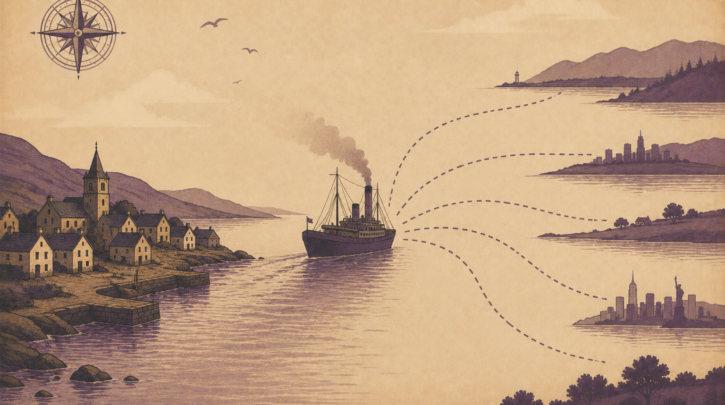

Few nations of Scotland’s size have scattered so many of their people across the world. From the 1700s into the twentieth century, Scots left in enormous numbers—driven out by the Highland Clearances, pushed by poverty and the upheavals of industrial change, and pulled by the promise of land and opportunity in North America, Australia, New Zealand and across the British Empire. The result is a Scottish diaspora many times larger than Scotland’s own population, and if your family came from Scotland, they were almost certainly part of it. This guide tells the story and shows how to trace an ancestor through it.
The scale of it
Scotland was one of the great emigrant nations of Europe, sending out a share of its people that few countries matched. The movement was sustained across two centuries, and it reshaped both Scotland—emptying whole Highland glens—and the lands the emigrants settled, from the Maritimes of Canada to the American frontier, the Australian bush and the hills of New Zealand. For the family historian, the scale means two things: your emigrant ancestor was one of a vast, documented movement, and the records that movement generated are rich and findable.
Not sure where to start with your Scottish ancestry?
Get the Scottish Genealogy Quick-Start Checklist — a 5-step path to your first real ancestor record, plus the one archive that holds almost everything.
Highland and Lowland
It is important to distinguish two very different Scottish emigrations. The Highland emigration is the famous, tragic one—bound up with the collapse of clan society and the Highland Clearances, in which tenants were removed from the land, many forced overseas. The Lowland emigration was larger still but different in character—driven by agricultural change, industrial upheaval and the pursuit of opportunity, sending Lowland Scots to the cities and farms of the New World. Both are part of your possible heritage, and knowing which your family belonged to shapes their story; we explore the causes in why Scots emigrated.
The Scots-Irish
There is also a third, often-misunderstood strand. Many Americans who think of themselves as “Scottish” or “Irish” in fact descend from the Scots-Irish—Lowland Scots who settled in Ulster in the 1600s and whose descendants emigrated to colonial America in huge numbers in the 1700s. They are neither simply Scottish nor simply Irish, and their story, told in the Scots-Irish and Ulster Scots, is one of the most important in American ancestry.
Where they went
Scots settled across the English-speaking world, but a few destinations stand out:
- Canada — perhaps the most Scottish of destinations, from Nova Scotia (“New Scotland”) and Cape Breton to Glengarry in Ontario; see Scottish emigration to Canada.
- The United States — from colonial Highland and Scots-Irish settlements to later industrial migration; see Scottish settlements in America.
- Australia and New Zealand — major nineteenth-century destinations, with strongly Scottish areas such as Otago in New Zealand.
The records of the migration can lead you back to the ancestral parish. See how in finding your Scottish emigrant ancestor, and begin your research on the records hub.
Tracing an emigrant ancestor
For the genealogist, the great migration is not just history but a documented trail. Passenger lists, the records your ancestor generated abroad, and—crucially—the Scottish census and statutory records they left before leaving can carry you from an immigrant in Ontario or the Carolinas back to a specific parish in Scotland—and from there into the deep parish registers. The whole method is laid out in finding your Scottish emigrant ancestor.
A story worth recovering
The Scottish diaspora is one of the defining facts of the modern Scottish people, remembered in song, in the Highland games held around the world, and in the fierce pride of the diaspora in its origins. Behind the vast numbers were individual families making a hard choice—or having it made for them—to leave everything for an uncertain future. Recovering your family’s particular story, from the glen or burgh they left to the place they built a new life, is what this cluster of guides, and this whole site, is here to help you do.
What the diaspora means for your research
For the family historian, the sheer scale and documentation of the Scottish migration is good news. Your emigrant ancestor was not an isolated wanderer but part of a mass movement that generated passenger lists, naturalisation papers, church records and community histories on the receiving side, and left statutory and census traces on the Scottish side. The clustering of the diaspora—Scots from one district settling together abroad—means that even when your own family’s origin is unclear, the origins of their neighbours and fellow parishioners often point the way. Understanding the migration as a whole is therefore not just background but a practical framework for locating one family within it, and for knowing which records, on which side of the ocean, are most likely to carry the story back to a Scottish parish.