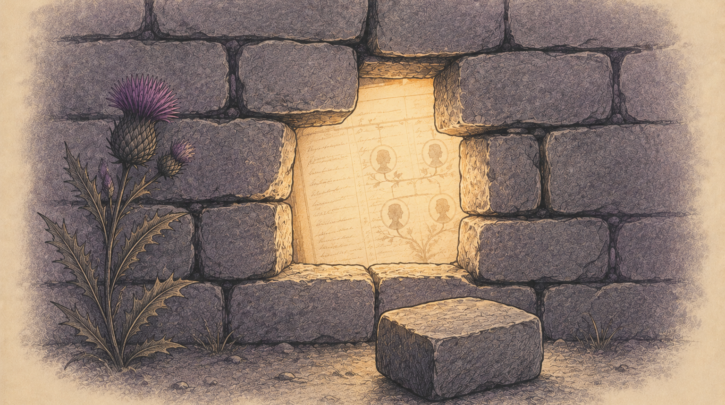

Every Scottish family historian hits a wall eventually—a family that vanishes before 1855, a parish register with a gap, a surname shared by half the glen. The encouraging news is that Scottish brick walls tend to fall into a handful of recognisable types, each with known solutions, and Scotland’s rich records give you good tools to break them. This guide covers the most common walls and how to get past them.
Wall 1: You don’t know the parish
The most common reason Scottish research stalls is not knowing the parish—you have only a county, a misspelled name, or nothing at all. Since the records are organised by place, this stops everything. The fix is to work from the emigrant’s own records and the census birthplace, as detailed in finding your ancestral parish. Establish the place, and the wall usually falls.
Not sure where to start with your Scottish ancestry?
Get the Scottish Genealogy Quick-Start Checklist — a 5-step path to your first real ancestor record, plus the one archive that holds almost everything.
Wall 2: Gaps in the old parish registers
Before 1855, the OPRs are uneven—a register may have gaps, begin late, or barely record burials. When an expected entry is missing, it may simply never have been recorded. Look to neighbouring parishes, to the kirk session records that can supply what the register omits, and to the naming pattern and family reconstruction to bridge the gap indirectly.
Wall 3: The family wasn’t in the Church of Scotland
A distinctively Scottish wall: your family may be missing from the OPRs because they belonged to another church. Scotland had many dissenting congregations, and the great Disruption of 1843 saw a large part of the population leave the Church of Scotland for the new Free Church—whose registers are separate from the OPRs. Catholics, Episcopalians and other groups likewise kept their own records. If a family vanishes from the Church of Scotland registers, especially around or after 1843, look for them in the records of these other churches.
Wall 4: Common surnames
Scotland’s common surnames—and the clustering of clan names in particular districts—mean a parish may hold many same-named, unrelated families. The solution is to stop relying on the surname and reconstruct the whole family group: the specific combination of given names (guided by the naming pattern), spouse, parents, dates and place, using the census and vital records to tell the families apart.
Scotland’s deep records give you the tools to break most walls—keep digging via the official ScotlandsPeople service, all on the records hub.
Wall 5: The 1855 divide and other gaps
The move from the detailed statutory records to the thinner OPRs at 1855 can feel like a wall in itself, as the evidence suddenly thins. The answer is to gather every detail from the last statutory records—which name parents and places—before crossing, so you know exactly whom to seek in the OPRs. For deeper walls, Scottish records beyond the vital registers—kirk sessions, wills and testaments, valuation rolls—can sometimes carry a line past a gap.
A method for any wall
Whatever the obstacle, the same disciplined approach tends to break it: confirm the parish beyond doubt; reconstruct full family groups rather than chasing a single name; consider that a missing family may have belonged to another church; use the kirk session and other records to fill register gaps; and consider DNA to confirm a connection the documents leave uncertain. Patience and thoroughness, more than any single trick, carry a Scottish family tree past its walls—and Scotland’s remarkable records mean the walls are usually more passable than they first appear.
The power of collateral research
When a direct line stalls, the way around is frequently sideways. Collateral research—tracing your ancestor’s siblings, their spouses’ families, witnesses and neighbours—often produces the record that names the person you cannot find directly. A sibling’s fuller record may name the shared parents; a marriage may reveal a home parish; a witness or informant may turn out to be a relative who leads to another branch. In a system where common surnames make individuals easy to confuse, reconstructing the whole family and its connections, rather than chasing one name, is both the safeguard against error and the route past many walls.
Scotland’s detailed statutory records make collateral research especially effective, because each one names so many people—parents, spouses, informants—that a single sibling’s marriage or death record can supply the parental names your own ancestor’s record happens to omit or obscure. Widening the search from the individual to the family group is, again and again, what turns an apparent dead end into a documented connection.
When to bring in DNA or help
Some walls call for additional tools. DNA testing can confirm or suggest a connection the documents leave uncertain, and—through the clan and surname projects—is especially suited to Scottish surname questions. For a genuinely stuck line, a researcher experienced in Scottish records, or the knowledgeable Scottish genealogy community, can offer fresh eyes and techniques, including the more specialised sources—wills, sasines and land records, kirk session and court records—that lie beyond the vital registers. Knowing when to keep digging yourself and when to seek help or test is part of the craft. With Scotland’s deep and well-kept records, persistence is usually rewarded: the walls are real, but they are seldom the end of the road.