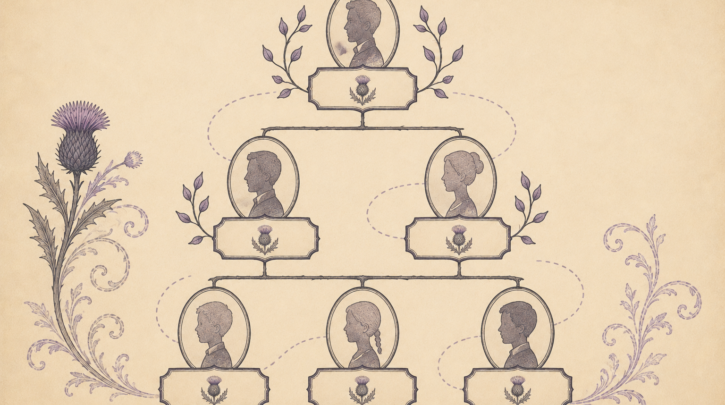

Among the most useful things a Scottish researcher can know is the traditional naming pattern—the custom by which many Scottish families named their children after particular relatives, in a set order. Far from mere trivia, it is a genuine research tool: it can help you predict the names of grandparents you have not yet found, and confirm that you have the right family. This guide explains the pattern and how to use it—and how not to over-rely on it.
The traditional pattern
The classic Scottish naming pattern ran, in its common form, like this:
- The first son was named after the father’s father (the paternal grandfather).
- The second son after the mother’s father (the maternal grandfather).
- The third son after the father himself.
- The first daughter after the mother’s mother (the maternal grandmother).
- The second daughter after the father’s mother (the paternal grandmother).
- The third daughter after the mother herself.
Later children were often named after aunts, uncles and other relatives. The pattern was common across much of Scotland, especially in earlier centuries, and where a family followed it, the names of the children encode the names of the grandparents.
Not sure where to start with your Scottish ancestry?
Get the Scottish Genealogy Quick-Start Checklist — a 5-step path to your first real ancestor record, plus the one archive that holds almost everything.
How to use it in research
Used carefully, the pattern is powerful. If you have a family’s children but not the grandparents, the eldest sons’ and daughters’ names suggest what the grandparents were called—a hypothesis to test against the parish registers. Conversely, if you have found candidate grandparents, the grandchildren’s names either fit the pattern (supporting the link) or do not (a warning to check). It is especially valuable in the OPR era, where records are thin and every clue counts.
The naming pattern is a clue, not proof—always confirm in the records. Trace and test your lines with the research guide and the records hub.
The important cautions
For all its usefulness, the pattern must be handled as a hint, never a rule. Not every family followed it; some ignored it entirely, and its use faded over time. It could be disrupted—a child who died young might have their name reused for a later sibling, or a family might break the pattern to honour a benefactor or a recently deceased relative. And a name that “fits” the pattern is suggestive, not conclusive, especially with common names. So treat the pattern as a way to generate and test hypotheses, always confirming any conclusion against the actual records.
A pattern worth knowing
Understood with these caveats, the Scottish naming pattern is one of the genealogist’s most elegant tools—a piece of cultural custom that quietly recorded the family tree in the names of the children. In the thin records of the seventeenth and eighteenth centuries, it can be the clue that lets you leap a generation or confirm a tentative link. Learn it, use it to point the way, and then let the registers do the proving—and you will find it repays the small effort of remembering it many times over.
A worked example
Suppose you find a couple, John and Mary, with sons William, James and John and daughters Janet and Agnes, but you cannot find the couple’s own parents. The naming pattern suggests a hypothesis: the eldest son William may be named for John’s father, the second son James for Mary’s father, and the third son John for the father himself; the eldest daughter Janet for Mary’s mother, the second daughter Agnes for John’s mother. You now have candidate grandparents’ names to search for in the parish registers—a set of testable predictions where before you had none. If the records turn up a John baptised to a William, the pattern and the register agree, and your hypothesis strengthens.
This is the pattern at its most useful: not proving anything by itself, but generating specific, checkable leads in exactly the thin-record situations where leads are scarce. Used this way—to point the search rather than to settle it—it can be the difference between a stalled line and a breakthrough, and it costs nothing but the knowledge of how it works.
When the pattern breaks
Equally important is recognising when the pattern has been broken, because that itself is informative. A first son not named for the paternal grandfather might mean the family did not follow the custom—or that the grandfather was already commemorated, that a wealthy relative was being honoured, or that a name was reused after a child died young (the tragic but common practice of giving a later child the name of a deceased sibling). Rather than forcing the evidence to fit, treat a broken pattern as a signal to look closer. Handled with this flexibility—as a guide to be tested, adjusted and sometimes set aside—the naming pattern remains one of the most quietly powerful tools in the Scottish researcher’s kit.