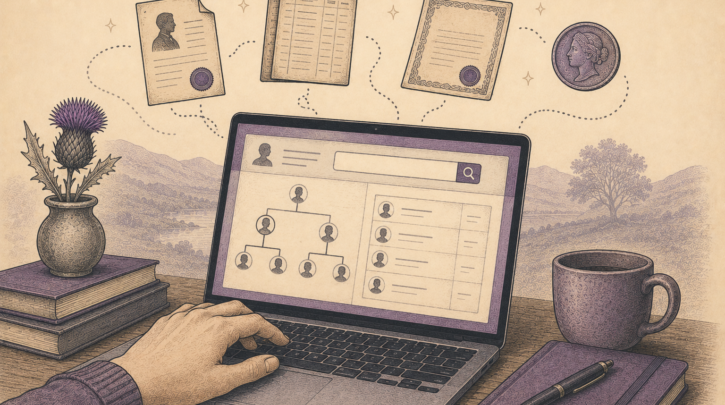

Almost all Scottish genealogy runs through one website: ScotlandsPeople, the official government service run by the National Records of Scotland. It holds the great majority of the records you will need—but, unlike the free national archives of some countries, it works on a pay-per-view basis. Understanding how it works, and how to search economically, is a core Scottish research skill. This guide explains it.
What ScotlandsPeople holds
ScotlandsPeople is the official home of Scotland’s records, and its collection is vast:
- Statutory records — births, marriages and deaths from 1855.
- Old parish registers — the Church of Scotland registers before 1855, plus Catholic and other church registers.
- Census records — the censuses from 1841 to 1921.
- Wills and testaments, valuation rolls, and kirk session records — among other records for deeper research.
Not sure where to start with your Scottish ancestry?
Get the Scottish Genealogy Quick-Start Checklist — a 5-step path to your first real ancestor record, plus the one archive that holds almost everything.
How the pay-per-view system works
The essential thing to grasp is that ScotlandsPeople charges to view record images. You buy credits, and viewing an image costs credits; some index searching is free or low-cost, while opening the actual record—the image or full details—is what you pay for. This is different from the free national archives elsewhere, and it means that careless searching wastes money. The good news is that the system is official, reliable and comprehensive; the skill is simply to search smartly.
Save money by searching before you spend. Use the (often free or cheap) indexes to identify the exact record—the right person, year and parish—before spending credits to view the image. A few minutes confirming you have the right entry avoids paying for the wrong one, and cross-checking free resources like FamilySearch first can narrow the search at no cost.
Searching economically
A disciplined approach keeps costs down. Start from what you already know—a name, an approximate year, a parish—and use the indexes to narrow candidates before viewing anything. Note that indexes may spell names variously, so search flexibly. Where a free platform such as FamilySearch holds an index or transcript of the same record, use it to pinpoint the entry first, then buy the official image from ScotlandsPeople only when you need the authoritative document. Buying credits in sensible amounts, and keeping notes of what you have already viewed, prevents both waste and duplication.
ScotlandsPeople is the official, authoritative source—worth the modest cost when used well. Pair it with the free resources noted on the records hub, and begin your research with the step-by-step guide.
In person and beyond
For those who can visit, the ScotlandsPeople Centre in Edinburgh offers on-site access to the records, and we cover research trips in researching in person. But for nearly everyone, the website is the way in—a single, official, comprehensive gateway to Scottish genealogy that, used with a little strategy, delivers extraordinary results for a modest outlay. Once you are comfortable navigating it, the whole of Scotland’s recorded past is a few searches away.
Free resources that complement it
Although ScotlandsPeople is the official and most complete source, it need not be your only one, and pairing it with free resources saves money. FamilySearch holds indexes and some transcripts of Scottish records at no cost, which can help you pinpoint an entry before you buy the official image. Free family trees and community resources can suggest lines to confirm. And general reference—gazetteers, parish maps, histories—costs nothing and sharpens your searches. The efficient pattern is to do the free groundwork first, narrowing to the exact record, and then turn to ScotlandsPeople for the authoritative document.
That said, treat free transcripts as clues, not conclusions. Indexes and transcripts contain errors, and for anything you intend to rely on—or that matters for a formal purpose—the official ScotlandsPeople image is the record that counts. Used together, the free tools and the official service form a complete and economical toolkit: the free resources for searching and narrowing, ScotlandsPeople for confirming and viewing the genuine article.
A realistic view of the cost
Some newcomers are taken aback that Scottish records are not free like the national archives of certain other countries. In perspective, though, the cost is modest for what you receive: a single, official, comprehensively indexed and imaged collection covering the whole country. Used with the search-before-you-spend discipline above, a serious research project costs a manageable sum, far less than travelling to archives or hiring help. And because the collection is so complete and authoritative, you are rarely left wondering whether a better source exists elsewhere—a genuine convenience that, for many researchers, more than justifies the pay-per-view model.