
In Scottish genealogy, the parish is the fundamental place—the community that recorded your family’s births, marriages and deaths, and very often somewhere that still stands much as they knew it, its church at the centre and its churchyard holding the family names. Visiting it is the most personal thing a heritage traveller can do. This guide explains how to make that visit meaningful: what to arrange in advance, what to see, and how to connect with the place your family came from.
Prepare before you arrive
A rewarding visit starts months earlier, with research. Identify your parish for certain, trace your family there in the records, and note the specific people, dates and places you want to connect with on the ground—the church of a baptism, the churchyard, a farm or address you have found in the census. Arriving with this knowledge transforms the visit: you are not wandering a pretty village but walking through your own documented history, knowing exactly which ancestors belonged to each place.
Wherever possible, make contact in advance. A polite message to the parish church, a local heritage or family-history society, or a local historian—explaining that you descend from a family of the parish—can arrange access, point you to the family’s part of the churchyard, and share local knowledge no record holds. Scotland being English-speaking, such contact is straightforward, and the welcome a returning descendant receives is often genuinely warm.
Not sure where to start with your Scottish ancestry?
Get the Scottish Genealogy Quick-Start Checklist — a 5-step path to your first real ancestor record, plus the one archive that holds almost everything.
The church and the churchyard
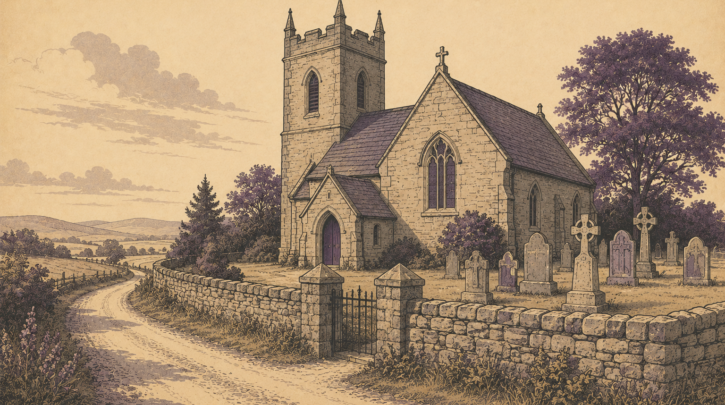
For many travellers the church and churchyard are the most moving places of all. The parish church—or its successor on the same site—is very likely where your ancestors were baptised, married and worshipped, and many Scottish churches are old and atmospheric, some medieval. The churchyard may hold family gravestones, and older Scottish stones can be wonderfully informative, sometimes recording several family members and their relationships. Bear in mind that not every grave was marked or survives, and that the poorest families often left no stone—but standing where generations of the parish are buried connects you physically to your people. Bring your traced line, a notebook and a camera, and take a quiet moment when you find the family names.
Find the parish and your family in it before you go—everything follows from that. The records hub has the tools, and the heritage trip guide shows how to weave the visit into a full itinerary.
Meeting local people
An ancestral parish often still holds knowledge, and sometimes family. If a DNA test or earlier correspondence has connected you with cousins, meeting them in person is an experience no archive can match—they can show you the family’s places and share stories and photographs. Even without prior contact, a local heritage society, the keeper of the churchyard, a long-settled resident, or the parish office may remember families or point you to a relative. Approach such encounters with warmth and genuine curiosity, and you will often find people generous with their time and local knowledge.
Reading the landscape—and the right to roam
Because Scotland has digitised so much, you may already have seen your family’s actual records online before you arrive—so the visit is less about finding documents than about experiencing the place. Give yourself time simply to be in the landscape: walk the fields, hills or glen your ancestors knew, see the church tower they walked toward, take in the country that shaped them. Scotland’s right to roam—a legal freedom to access most land and water responsibly—lets you explore the countryside and ancestral glens far more freely than in many countries, provided you follow the access code and respect the land. Standing in the country that formed your family is what finally turns a name in a register into an ancestor, and it is often the moment the whole journey through the records was quietly leading toward.
Reading the parish itself
Beyond the specific sites, an ancestral parish rewards a slower, attentive look, because the place itself is a kind of record. The church at its centre, the surrounding farms and fields, the hills, the coast or the glen—all of it is the physical world your ancestors moved through. Rural Scotland has changed less in many places than you might expect, and the church your family walked to, the land they worked, and sometimes the very farm or township named in the census may still be there to see. Walking it with that awareness turns sightseeing into something closer to communion with the people who lived there, and often stirs a sense of connection that surprises even seasoned researchers.
It helps, too, to learn the parish’s own history before or during your visit—its story through the centuries, its part in events like the Clearances or the religious upheavals of the Disruption, its industries and its character. Understanding what happened in the parish deepens your sense of your family’s life there, and explains much—why they stayed, why they left, how they lived. A parish is not just a dot on a map but a community with a history, and knowing that history is part of truly visiting it.
Photographs and respect
Photograph generously but thoughtfully—the church and churchyard, family gravestones, the farm and landscape, the parish sign with its name—so that these images become part of your family record and gifts for relatives who cannot make the journey. Remember that churches and churchyards are living, sacred places, not tourist attractions: visit quietly, follow any guidance, and if a service is under way, wait or join respectfully. The care you show honours both the place and the ancestors who made it yours, and it is part of beginning to reclaim the heritage you came to find.