
If you have established that you may have a genuine route to British citizenship—an unbroken claim, a registration route, or naturalisation—the next honest question is what claiming it actually involves in time, paperwork and money. British citizenship applications are formal, document-heavy and, frankly, expensive, and it is far better to know that up front than to be surprised. This guide sets out the process and the costs as they stand, so you can plan realistically.
Important: This article is general information for educational purposes, not legal advice. British nationality law is complex and highly fact-specific, the rules and fees change, and any individual case depends on its particular details. Always verify your situation with the UK Home Office (GOV.UK) and consider consulting a qualified immigration adviser before acting.
Not sure where to start with your Scottish ancestry?
Get the Scottish Genealogy Quick-Start Checklist — a 5-step path to your first real ancestor record, plus the one archive that holds almost everything.
First, confirm which application you need
The process depends on how you qualify, so the first step is to identify the right application type. Broadly, if you are already British by descent and simply need to prove it, you may be applying for a passport (documenting a citizenship you already hold) rather than for citizenship itself. If you qualify through a registration route—such as a historical-unfairness correction—you make a registration application. If your route is naturalisation by residence, that is a different application again. Getting the category right matters, because each has its own form, requirements, evidence and fee; the Home Office (GOV.UK) sets these out, and expert advice can help you choose correctly.
The fees are significant
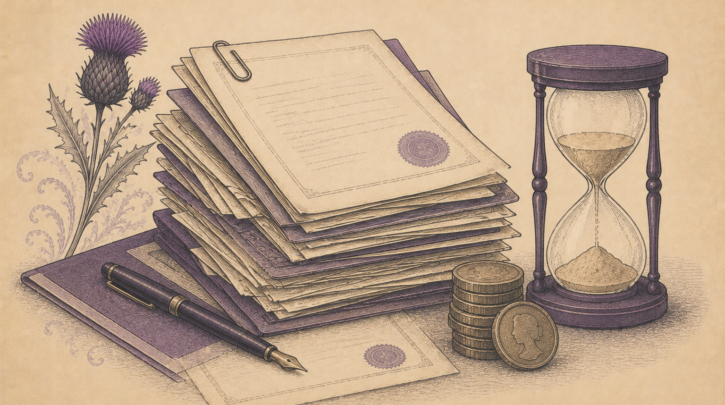
There is no gentle way to say it: British citizenship applications carry high fees. As of 2026, the fee to register as a British citizen (adult) is on the order of £1,540, with a lower fee for a child, and there is typically a separate citizenship ceremony fee (around £130) for registration and naturalisation. Naturalisation carries its own substantial fee. Proving an existing citizenship through a first UK passport application is cheaper than registration but still involves a fee and rigorous documentation. These figures change over time, so always check the current fees on GOV.UK before you plan—but budget on the basis that a citizenship route is a serious financial commitment, not a formality.
The documents and the process
Whatever the route, expect to prove your case with thorough documentation. That generally means the civil records establishing the relevant births, marriages and the citizenship status of each link in the chain—precisely the records this site helps you gather, plus the records from your own country. Applications are made to the Home Office, usually online via GOV.UK, and typically involve providing biometrics (fingerprints and a photograph) at a designated centre. For registration and naturalisation, successful applicants attend a citizenship ceremony. Processing times vary but often run to around six months, sometimes longer, so patience is required.
Solid documentation is the heart of any application. Build it with the research guide and the records hub, and confirm the current process and fees on the UK Home Office site (GOV.UK).
Do you need to live in the UK?
A common and important question: if you qualify by descent or registration, you generally do not need to live in the UK to claim—the claim rests on your ancestry and the law, not on residence, so you can apply from abroad. Naturalisation, by contrast, is fundamentally a residence route: it requires actually living lawfully in the UK for a qualifying period and meeting further conditions. So the residence question depends entirely on which route is yours—an ancestry-based claim can be pursued from your home country, while naturalisation means genuinely relocating to Britain.
Plan realistically
Taken together, the cost, the documentation and the timeline mean a British citizenship application is a considered undertaking, not a quick win. If you have a genuine route, it can be very much worth it—but go in with clear eyes: confirm the correct application type, budget for the substantial fees, assemble rigorous documentation, and expect a process of months. And if, like most descendants, you find you have no qualifying route, spare yourself the expense and disappointment of pursuing one that does not fit—and turn instead to the heritage, which asks no application fee at all.
Avoiding common pitfalls
A few mistakes cost applicants time and money, and all are avoidable. The first is applying under the wrong category—for instance, applying to register when you are in fact already a citizen who simply needs a passport, or vice versa—which wastes fees and delays everything; confirming your exact route before you apply is essential. The second is incomplete documentation: because the Home Office must see the chain of relationships and statuses proven, a missing record can stall or sink an application, so assemble the full set of civil records—yours and your ancestors’—before you begin. The third is relying on out-of-date fee or rule information, since both change; always check the current position on GOV.UK. And the fourth is falling for overpriced or overpromising services that imply an ancestry route exists where the law offers none. Careful preparation, honest expectations, and the official GOV.UK guidance are your best protection—and where a case is genuinely complex, a reputable qualified adviser is worth the cost.
It also helps to treat the documentation as a project in its own right, begun well before you apply. The Scottish statutory records and, where needed, the older registers supply the Scottish end of the evidence, while the records of your own country supply the rest. Building this file methodically not only smooths any application but leaves you, whatever the outcome, with a thoroughly documented family history.