
Having set out the sobering general picture—that most descendants of Scottish emigrants have no citizenship claim—it is worth looking carefully at who genuinely does qualify. A minority of people with British ancestry have a real route, and some may even be British already without realising it. This guide sets out the genuine possibilities honestly, so you can assess whether you might be among them. Because individual cases turn on precise facts, treat this as a map of the routes, not a verdict on your case.
Important: This article is general information for educational purposes, not legal advice. British nationality law is complex and highly fact-specific, the rules and fees change, and any individual case depends on its particular details. Always verify your situation with the UK Home Office (GOV.UK) and consider consulting a qualified immigration adviser before acting.
Not sure where to start with your Scottish ancestry?
Get the Scottish Genealogy Quick-Start Checklist — a 5-step path to your first real ancestor record, plus the one archive that holds almost everything.
Route 1: An unbroken one-generation claim
The clearest route is the basic one: if a parent of yours was a British citizen otherwise than by descent (for example, born in the UK) when you were born, then even if you were born abroad you are very likely British by descent—you may already be a citizen and simply need to document it. This is the situation of many children of UK-born emigrants. The key question is whether the parent through whom you claim was themselves UK-born (or otherwise “otherwise than by descent”) at your birth—if so, your claim may be straightforward.
Route 2: Registration correcting historical unfairness
British nationality law has, over the years, contained unfairnesses that later reforms created routes to correct—usually by registration (an application) rather than automatic citizenship. The most significant for descendants is the historical gender discrimination: before 1983, British mothers generally could not pass on citizenship as fathers could, cutting off maternal-line claims. Reforms introduced routes to register in such cases. Other corrective routes address, for example, the children of unmarried British fathers. If your claim runs through a line that historical law treated unfairly—especially a maternal line before 1983—one of these registration routes may open a door that the basic rules appear to close.
Route 3: Residence-based registration and naturalisation
Other routes depend on a connection to the UK through residence rather than pure descent. Certain people who have lived in the UK, or who were born there in defined circumstances, may be able to register as British citizens. And for those willing to move to the UK and build a life there, naturalisation by residence is the general route open to any qualifying resident—not an ancestry route, but a genuine path for those who actually intend to live in Britain. Scottish ancestry gives no special advantage in naturalisation, but it is the honest answer for many who have no descent claim.
Whether a route fits you turns on exact family facts—dates, places and each generation’s status. Document them with the research guide, then confirm eligibility with the UK Home Office or a qualified adviser.
How to assess your own situation
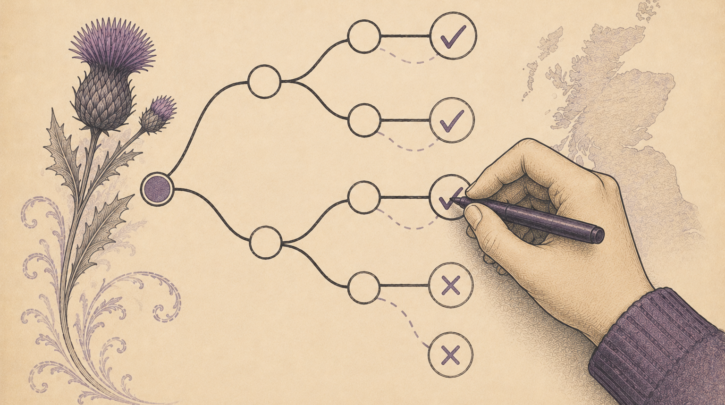
To gauge your position honestly, work down the generations from your British-born ancestor and ask, at each step, whether British citizenship was actually held and could be passed on—paying close attention to where each person was born and whether the parent passing it on was “otherwise than by descent” or “by descent.” Note any maternal-line link before 1983, any pre-1983 births, and any UK residence, as these can trigger the special routes. This self-assessment will not give a definitive legal answer—only the Home Office or a qualified adviser can—but it tells you quickly whether your case is worth pursuing and which route to ask about.
The honest bottom line
For most descendants of nineteenth- and early-twentieth-century Scottish emigrants, this assessment ends without a claim: the chain broke under the one-generation rule, and none of the special routes apply. That is genuinely disappointing, and we will not pretend otherwise. But for the minority—those with a UK-born parent, a maternal line unfairly cut off before 1983, a pre-1983 birth, or a UK-residence connection—a real route may exist, and is well worth pursuing with proper advice. And for everyone, qualifying or not, the heritage remains fully yours.
Gather the evidence either way
Whether or not you expect to qualify, the evidence you would need is worth gathering for its own sake, and it is the same evidence that builds a family history. That means the birth records establishing where each ancestor was born (the pivotal fact under the one-generation rule), the marriage records, and any documentation of each generation’s citizenship status—naturalisation abroad, UK residence, and so on. Assembling these answers the citizenship question and, at the same time, produces the documented tree that is the real reward of the search. If the evidence reveals a live route—a UK-born parent, a maternal line unfairly cut off before 1983, a pre-1983 birth—you can take it to the Home Office or a qualified adviser with your case already well prepared. If it confirms no route exists, you have lost nothing but a hope you were right to test, and gained a genuine family history in the process. Our records guides show how to gather exactly this evidence.