
At the heart of British nationality law—and of why most descendants of Scottish emigrants cannot claim citizenship—lies a distinction that sounds like jargon but decides everything: the difference between a British citizen “otherwise than by descent” and one “by descent.” Master this single concept and you understand the whole logic of British citizenship by ancestry, including why it usually reaches only one generation abroad. This guide explains it plainly, with an example.
Important: This article is general information for educational purposes, not legal advice. British nationality law is complex and highly fact-specific, the rules and fees change, and any individual case depends on its particular details. Always verify your situation with the UK Home Office (GOV.UK) and consider consulting a qualified immigration adviser before acting.
The two kinds of British citizen
Under the British Nationality Act 1981, which took effect on 1 January 1983, British citizens fall into two categories that look identical on a passport but behave very differently when it comes to passing citizenship to children born abroad:
- British citizen ‘otherwise than by descent’ — broadly, someone who acquired citizenship through a connection to the UK itself, most commonly by being born in the UK (or by naturalisation or registration there). Their citizenship is, in a sense, “first-hand.”
- British citizen ‘by descent’ — broadly, someone who was born abroad and acquired British citizenship through a parent. Their citizenship is, in a sense, “inherited” from a parent rather than from a personal UK connection.
Not sure where to start with your Scottish ancestry?
Get the Scottish Genealogy Quick-Start Checklist — a 5-step path to your first real ancestor record, plus the one archive that holds almost everything.
The rule that changes everything
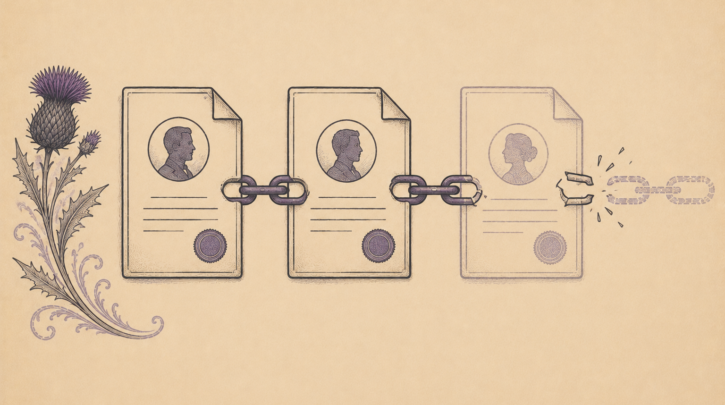
Here is the decisive part. A British citizen otherwise than by descent can pass citizenship to their child even if that child is born abroad—the child becomes a British citizen by descent. But a British citizen by descent generally cannot automatically pass citizenship to a child who is also born abroad. In other words, the “inherited” form of citizenship usually cannot be passed on again to the next generation abroad. This is what produces the famous one-generation limit: citizenship can travel one step outside the UK, but generally not a second step.
A worked example
Picture a typical Scottish emigrant family and watch where the chain stops:
- Your great-grandfather was born in Scotland—so he was British otherwise than by descent.
- He emigrated, and your grandfather was born abroad. Through his UK-born father, your grandfather could be British by descent.
- Your father was then also born abroad—to a father (your grandfather) who was British by descent. Because a by-descent parent generally cannot pass citizenship to a child born abroad, your father was not a British citizen.
- With your father not British, you have no claim to pass down to either. The chain broke at your father’s generation.
This is precisely the situation of most people whose Scottish ancestor emigrated in the 1800s or early 1900s: the citizenship, if it survived at all, reached one generation born abroad and then stopped.
Whether your chain survived is a question of each generation’s birthplace and status. Trace the line with the research guide, then verify any claim with the UK Home Office.
Why the rule exists
The logic behind the rule is that citizenship by descent is meant to connect people who have a real, living link to the UK, not to pass indefinitely down generations of a family that has settled permanently abroad and may have no other connection to Britain. Allowing citizenship by descent to be passed on endlessly would, over generations, produce ever-larger numbers of citizens with no genuine tie to the country. The one-generation limit—citizenship reaching those born abroad to a UK-connected parent, but generally no further—is Parliament’s way of drawing that line. Whatever one thinks of it, it is the rule, and it explains the disappointment so many descendants encounter.
The exceptions worth knowing
The one-generation rule is the default, but not quite the whole story, and this is where honest hope lies for a minority. There are narrow grandparent (“double descent”) provisions and various registration routes—some correcting historical unfairness—that can, in specific circumstances, allow citizenship to reach further than the basic rule suggests. They are limited and fact-specific, and they do not amount to a general ancestry entitlement. But if any apply to you, they matter enormously, which is why understanding the basic rule and its exceptions is the essential foundation for assessing your own situation honestly.